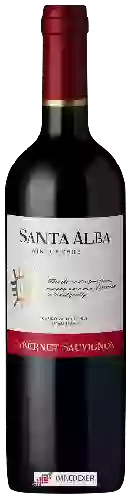
The Winery Santa Alba of Curico Valley of Central Valley

The Winery Santa Alba is one of the best wineries to follow in Curico Valley.. It offers 28 wines for sale in of Curico Valley to come and discover on site or to buy online.
Looking for the best Winery Santa Alba wines in Curico Valley among all the wines in the region? Check out our tops of the best red, white or effervescent Winery Santa Alba wines. Also find some food and wine pairings that may be suitable with the wines from this area. Learn more about the region and the Winery Santa Alba wines with technical and enological descriptions.
How Winery Santa Alba wines pair with each other generally quite well with dishes of beef, lamb or game (deer, venison) such as recipes of oxtail with seed sauce, shoulder of lamb in a crust or rabbit with white wine.
On the nose the red wine of Winery Santa Alba. often reveals types of flavors of non oak, earth or oak and sometimes also flavors of red fruit, tree fruit or black fruit. In the mouth the red wine of Winery Santa Alba. is a powerful with a nice freshness.
Curicó Valley is a wine-producing region in CentralChile, located roughly 115 miles (185km) South of the Chilean capital, Santiago. It is divided into two sub-regions: Teno in the North and Lontue Valley in the south. The Curicó is known for its reliable, good value everyday wines, Particularly the reds made from Cabernet Sauvignon and whites from Sauvignon Blanc and Chardonnay.
Curicó's vineyards are planted with more varieties than anywhere else in Chile.
The first two grapes mentioned above are the most heavily planted, as they were when the region first appeared on the international wine map.
The reds may not consistently rival the best from Maipo, and its Sauvignon Blanc may not quite match the fresh, Complex style found in Casablanca, but the valley is one of Chile's workhorse regions and its output is consistent and reliable.
Curicó Valley growing conditions
With respect to Climate, the eastern part of the valley – closer to the Andes Mountains – is cooler than the western section as it benefits from breezes coming down from the slopes of the Andes. In this way, it differs from regions further north, where the western ends of the valleys, being influenced by the Pacific Ocean, are generally cooler.
In Curicó, however, the hills of the Coastal Ranges dissipate the effect of east–west air movements. The major centers of production and the established high profile wineries (Echeverria, Montes, Viña San Pedro, TTorres and Valdivieso) are located around the cooler eastern towns of Curicó and Molino.
The meltwater rivers Lontue and Teno that Flow through Curicó Valley (before converging to form the Mataquito River) have a significant effect on viticulture here. The region's varied soils are derived from limestone and volcanic rock from the Andes and have been deposited in the valley over time by the rivers (alluvial) as well as by gravity (colluvial).
How Winery Santa Alba wines pair with each other generally quite well with dishes of pork, rich fish (salmon, tuna etc) or vegetarian such as recipes of bare-assed cockerel (ardennes), smoked salmon and herb sandwich cakes or magic cake cheese quiche.
On the nose the white wine of Winery Santa Alba. often reveals types of flavors of citrus fruit, tree fruit or vegetal. In the mouth the white wine of Winery Santa Alba. is a powerful with a nice freshness.
Cabernet Franc is one of the oldest red grape varieties in Bordeaux. The Libourne region is its terroir where it develops best. The terroirs of Saint-Emilion and Fronsac allow it to mature and develop its best range of aromas. It is also the majority in many blends. The very famous Château Cheval Blanc, for example, uses 60% Cabernet Franc. The wines produced with Cabernet Franc are medium in colour with fine tannins and subtle aromas of small red fruits and spices. When blended with Merlot and Cabernet Sauvignon, it brings complexity and a bouquet of aromas to the wine. It produces fruity wines that can be drunk quite quickly, but whose great vintages can be kept for a long time. It is an earlier grape variety than Cabernet Sauvignon, which means that it is planted as far north as the Loire Valley. In Anjou, it is also used to make sweet rosé wines. Cabernet Franc is now used in some twenty countries in Europe and throughout the world.
How Winery Santa Alba wines pair with each other generally quite well with dishes of veal, pork or game (deer, venison) such as recipes of veal cutlets with savoy tomme, stuffed artichoke or wild boar stew (without marinade or wine).
Said of a wine with a full and expressive nose, generally at its peak.
How Winery Santa Alba wines pair with each other generally quite well with dishes such as recipes .
Merlot noir is a grape variety that originated in France (Bordeaux). It produces a variety of grape specially used for wine making. It is rare to find this grape to eat on our tables. This variety of grape is characterized by small to medium sized bunches, and medium sized grapes. Merlot noir can be found in many vineyards: South West, Languedoc & Roussillon, Cognac, Bordeaux, Loire Valley, Armagnac, Burgundy, Jura, Champagne, Rhone Valley, Beaujolais, Provence & Corsica, Savoie & Bugey.
Planning a wine route in the of Curico Valley? Here are the wineries to visit and the winemakers to meet during your trip in search of wines similar to Winery Santa Alba.
The white Chardonnay is a grape variety that originated in France (Burgundy). It produces a variety of grape specially used for wine making. It is rare to find this grape to eat on our tables. This variety of grape is characterized by small bunches, and small grapes. White Chardonnay can be found in many vineyards: South West, Burgundy, Jura, Languedoc & Roussillon, Cognac, Bordeaux, Beaujolais, Savoie & Bugey, Loire Valley, Champagne, Rhone Valley, Armagnac, Lorraine, Alsace, Provence & Corsica.