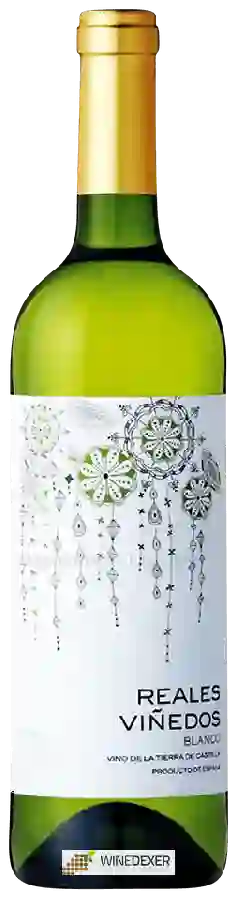
Winery Real Compania de VinosReales Viñedos Blanco
 White wine


This wine generally goes well with pork, vegetarian or rich fish (salmon, tuna etc).
Food and wine pairings with Reales Viñedos Blanco
Pairings that work perfectly with Reales Viñedos Blanco



Original food and wine pairings with Reales Viñedos Blanco


The Reales Viñedos Blanco of Winery Real Compania de Vinos matches generally quite well with dishes of pork, rich fish (salmon, tuna etc) or shellfish such as recipes of pasta carbonara, sea bream in foil on the barbecue or sea sauerkraut with white wine.
Details and technical informations about Winery Real Compania de Vinos's Reales Viñedos Blanco.
Discover the grape variety: Verdejo
An ancient grape variety that has been cultivated for a long time, mainly in the Rueda region of northwestern Spain. D.N.A. tests show that it is the result of a natural cross between Savagnin and Castellana Blanco. It should not be confused with the Verdelho, which is very well known in Portugal, and the Verdelho Branco, which is almost more widespread. The Verdejo is registered in the Official Catalogue of wine grape varieties list A. It can also be found in the United States (Virginia, California, etc.), Australia, Portugal, etc., but is practically unknown in France.
Last vintages of this wine

The best vintages of Reales Viñedos Blanco from Winery Real Compania de Vinos are 2016, 2014, 0, 2018 and 2013.
Informations about the Winery Real Compania de Vinos
The Winery Real Compania de Vinos is one of of the world's great estates. It offers 21 wines for sale in the of Castille to come and discover on site or to buy online.

The wine region of Castille
Castilla-La Mancha is a large region located South and east of the Spanish capital, Madrid. Inexpensive table wines are produced from a variety of Grapes. Higher quality wines are increasingly available, but the region is traditionally known as a source of low quality bulk wine. More than half of Spain's grapes are grown here.
The word of the wine: Presses
The juice that results from pressing the grapes after fermentation. At the end of the maceration, the vats are emptied, the first juice obtained is called the free-run wine and the marc remaining at the bottom of the vat is then pressed to give the press wine. We say more quickly "the presses". Their quality varies according to the vintage and the maceration. A too vigorous extraction releases the tannins of pips and the wine of press can then prove to be very astringent. Often the winemaker raises it separately, deciding later whether or not to incorporate it totally or partially into the grand vin.