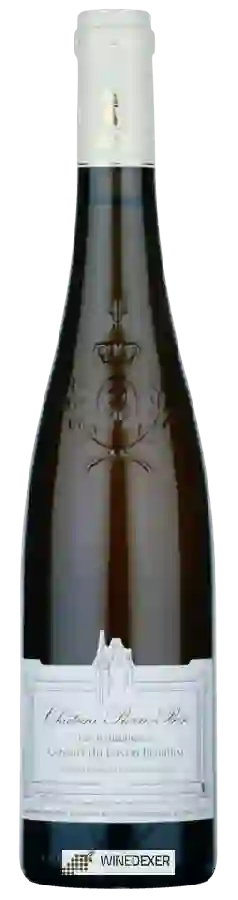
Château Pierre-BiseLes Rouannières Coteaux du Layon 'Beaulieu'
 Sweet wine


In the mouth this sweet wine is a with a good balance between acidity and sweetness.
This wine generally goes well with vegetarian, poultry or rich fish (salmon, tuna etc).
The Les Rouannières Coteaux du Layon 'Beaulieu' of the Château Pierre-Bise is in the top 20 of wines of Coteaux du Layon 'Beaulieu-sur-Layon'.

Taste structure of the Les Rouannières Coteaux du Layon 'Beaulieu' from the Château Pierre-Bise
Light | Bold | |
Dry | Sweet | |
Soft | Acidic |
In the mouth the Les Rouannières Coteaux du Layon 'Beaulieu' of Château Pierre-Bise in the region of Loire Valley is a with a good balance between acidity and sweetness.
Wine flavors and olphactive analysis






On the nose the Les Rouannières Coteaux du Layon 'Beaulieu' of Château Pierre-Bise in the region of Loire Valley often reveals types of flavors of pineapple, cream or citrus and sometimes also flavors of beeswax, apples or peach.
Food and wine pairings with Les Rouannières Coteaux du Layon 'Beaulieu'
Pairings that work perfectly with Les Rouannières Coteaux du Layon 'Beaulieu'



Original food and wine pairings with Les Rouannières Coteaux du Layon 'Beaulieu'

The Les Rouannières Coteaux du Layon 'Beaulieu' of Château Pierre-Bise matches generally quite well with dishes of rich fish (salmon, tuna etc), vegetarian or poultry such as recipes of croque-monsieur with tuna, ham and comté quiche or mediterranean cake with parmesan and coppa gratin.
Details and technical informations about Château Pierre-Bise's Les Rouannières Coteaux du Layon 'Beaulieu'.
Discover the grape variety: Chenin blanc
Chameleon whites with taut acidity, ranging from mineral dry (Savennières, Vouvray sec) to off-dry and medium-sweet (Vouvray, Montlouis), sumptuous botrytised sweet (Quarts-de-Chaume, Bonnezeaux, Coteaux du Layon) and brilliant sparkling (Crémant de Loire, Vouvray brut). Aromas of quince, apple, honey, white flowers, beeswax and flint. An Anjou variety, also star of South Africa's Western Cape.
Last vintages of this wine
The best vintages of Les Rouannières Coteaux du Layon 'Beaulieu' from Château Pierre-Bise are 2017, 2004, 2018, 2015 and 2011.
Informations about the Château Pierre-Bise
The Château Pierre-Bise is one of of the world's greatest estates. It offers 29 wines for sale in the of Coteaux du Layon 'Beaulieu-sur-Layon' to come and discover on site or to buy online.

The wine region of Coteaux du Layon 'Beaulieu-sur-Layon'
Communal denomination of Coteaux du Layon (Anjou-Layon) on Beaulieu-sur-Layon: 100% Chenin, sweet by successive tries of botrytised grapes. Steep schist slopes facing south (brown schists and aeolian sands), Mauges massif shielding from Atlantic rain — ideal overripening and botrytis. Aromas of candied yellow fruits, honey, quince and dried apricot, sustained by mineral tension that avoids heaviness. Multi-decade ageing potential.
The wine region of Loire Valley
Kingdom of lively, dry whites and fine sparklers. Mineral, taut Sauvignon Blanc (Sancerre, Pouilly-Fumé) with citrus and gunflint notes. Multiform Chenin Blanc (Vouvray, Savennières, Layon): straight dry, floral off-dry or noble sweet honey-quince. Saline, iodised Muscadet (Melon B.
The word of the wine: Slight
Supple and easy to drink wine.