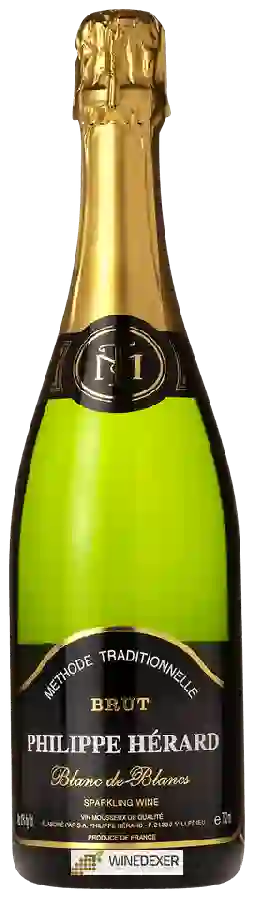
Winery Philippe HérardBlanc de Blancs Brut
 Sparkling wine


This wine is a blend of 3 varietals which are the Bourboulenc, the Chardonnay and the Chenin blanc.
This wine generally goes well with fruity desserts, pork or vegetarian.

Food and wine pairings with Blanc de Blancs Brut
Pairings that work perfectly with Blanc de Blancs Brut


Original food and wine pairings with Blanc de Blancs Brut



The Blanc de Blancs Brut of Winery Philippe Hérard matches generally quite well with dishes of pork, rich fish (salmon, tuna etc) or shellfish such as recipes of stuffed tomatoes with thermomix, raw salmon marinade with vinegars or scallops with cream.
Details and technical informations about Winery Philippe Hérard's Blanc de Blancs Brut.
Discover the grape variety: Bourboulenc
Fresh and aromatic whites with an ample palate and preserved acidity despite the sun, on discreet aromas of white flowers (broom), citrus, exotic fruits, fennel and saline marine notes. Very late-ripening, retaining freshness in hot climates. Essential component of white Châteauneuf-du-Pape AOC, white Côtes-du-Rhône and Bandol blanc, and the absolute signature of La Clape AOC. Native southern French variety with very late ripening.
Last vintages of this wine
The best vintages of Blanc de Blancs Brut from Winery Philippe Hérard are N.V.
Informations about the Winery Philippe Hérard
The Winery Philippe Hérard is one of of the world's greatest estates. It offers 10 wines for sale in the of Burgundy to come and discover on site or to buy online.

The wine region of Burgundy
Absolute reference for great terroir wines: opulent, mineral Chardonnay in whites (chiselled Chablis, buttery Meursault, majestic Montrachet), fine and silky Pinot Noir in reds (full-bodied Gevrey, structured Pommard, delicate Volnay). Exceptional age-worthy wines with complex notes - red fruits, undergrowth, butter, hazelnut. Some lively Aligoté and light Gamay (Mâconnais). 29,500 ha, 84 tiered AOCs (Régionale, Village, 1er Cru, Grand Cru), 1,247 UNESCO Climats.
The word of the wine: Maturing (champagne)
After riddling, the bottles are stored on "point", upside down, with the neck of one bottle in the bottom of the other. The duration of this maturation is very important: in contact with the dead yeasts, the wine takes on subtle aromas and gains in roundness and fatness. A brut without year must remain at least 15 months in the cellar after bottling, a vintage 36 months.