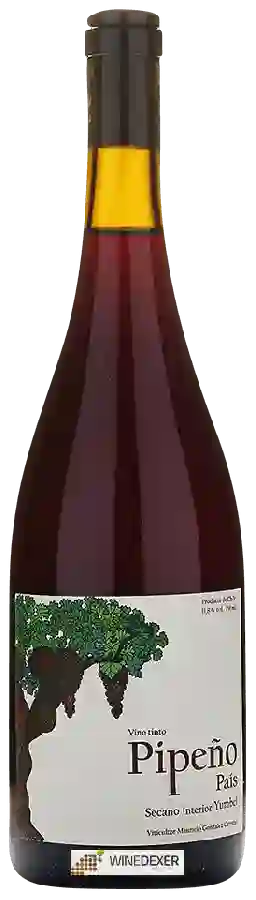
Winery Mauricio Gonzalez CarreñoPipeño País
 Red wine


This wine generally goes well with
The Pipeño País of the Winery Mauricio Gonzalez Carreño is in the top 10 of wines of Bio-Bio Valley.
Wine flavors and olphactive analysis



On the nose the Pipeño País of Winery Mauricio Gonzalez Carreño in the region of South often reveals types of flavors of smoke, earthy or red fruit and sometimes also flavors of strawberries, pepper or non oak.
Details and technical informations about Winery Mauricio Gonzalez Carreño's Pipeño País.
Discover the grape variety: Courbu
Courbu is indigenous to the Pyrenean vineyards. This white grape variety is part of the Jurançon family. Three clones are recognized in this variety, which buds in the medium term, develops regularly and has satisfactory productivity. The way in which the shoots form is characteristic. Initially upright, they bend and curve, giving a parasol-like finish to the vine. A vigorous rootstock is recommended to see the Courbu develop and mature at a late age. The small clusters display quite distinctive features. Not necessarily winged, they are pignate and stocky, with a rounded or rather flattened shape. A light pink veil covers the most mature berries, but the original colour varies from yellow-green to golden white. Vinification enhances the juice of this variety. The bouquet becomes more refined with age under a pale yellow colour. Dry or sweet, this wine is always remarkably fine.
Last vintages of this wine

The best vintages of Pipeño País from Winery Mauricio Gonzalez Carreño are 2018, 2016, 2017
Informations about the Winery Mauricio Gonzalez Carreño
The Winery Mauricio Gonzalez Carreño is one of of the world's greatest estates. It offers 4 wines for sale in the of Bio-Bio Valley to come and discover on site or to buy online.

The wine region of Bio-Bio Valley
Bío Bío Valley, which is one of Chile's most Southern wine-producing regions, has enjoyed a dramatic rise to fame since the start of the New millennium. The global appetite for its crisp, Aromatic wine styles is the major reason, coupled with the determination of Chilean winemakers to prove they can produce more than Cabernet Sauvignon and Merlot. Just as Casablanca has done with Sauvignon Blanc and Chardonnay, Bío Bío has provided an excellent place for Chilean winegrowers to work with varieties such as Riesling, Gewurztraminer and Viognier. The region Lies 435 kilometers (270 miles) south of the Chilean capital of Santiago, between the Andes Mountains and the Coastal Range.
The wine region of South
Malleco Valley is a Southern wine-growing region in Chile, some 540 kilometers (340 miles) south of the capital, Central-valley/maipo-valley/santiago">Santiago, in the Malleco province. The region is particularly challenging to Grape growers because of its marginal Climate, high rainfall and Short growing season, but the crisp, fresh wines produced here from Chardonnay, Sauvignon Blanc and Pinot Noir. are beginning to attract international attention. The wine industry in Malleco Valley is still in its embryonic stages, and there is less than 40 hectares (100 acres) under Vine here.
The word of the wine: Phenolic ripeness
A distinction is made between the ripeness of sugars and acids and the ripeness of tannins and other compounds such as anthocyanins and tannins, which will bring structure and colour. Grapes can be measured at 13° potential without having reached this phenolic maturity. Vinified at this stage, they will give hard, astringent wines, without charm.