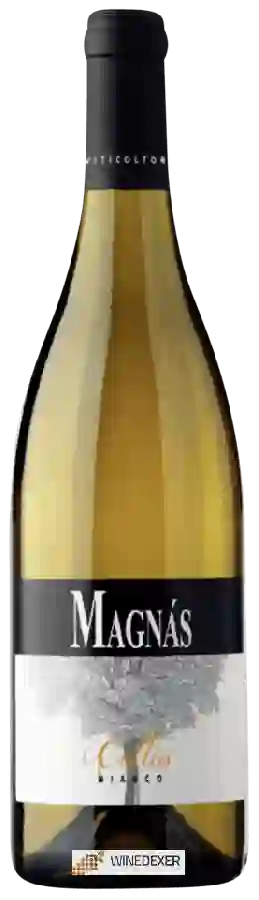
Winery MagnàsCollio Bianco
 White wine


In the mouth this white wine is a powerful.
This wine generally goes well with lean fish, shellfish or mature and hard cheese.

Taste structure of the Collio Bianco from the Winery Magnàs
Light | Bold | |
Dry | Sweet | |
Soft | Acidic |
In the mouth the Collio Bianco of Winery Magnàs in the region of Friuli-Venezia Giulia is a powerful.
Food and wine pairings with Collio Bianco
Pairings that work perfectly with Collio Bianco



Original food and wine pairings with Collio Bianco


The Collio Bianco of Winery Magnàs matches generally quite well with dishes of pasta, shellfish or mature and hard cheese such as recipes of pasta with arrabiata, mussels with camembert cheese or pork terrine with beaufort cheese.
Details and technical informations about Winery Magnàs's Collio Bianco.
Discover the grape variety: Oeillade blanche
Simple, dry whites with a pale golden robe, a supple palate with moderate acidity, and undemonstrative aromas of citrus and white flowers. Discreet southern rustic profile. Almost extinct, preserved in INRAE varietal collections for its heritage value, bearing witness to the pre-phylloxera ampelographic diversity of the southern vineyard. Rare French white grape, formerly grown in Provence and the south-east.
Last vintages of this wine
The best vintages of Collio Bianco from Winery Magnàs are 2017, 2016, 2015, 0
Informations about the Winery Magnàs
The Winery Magnàs is one of of the world's greatest estates. It offers 12 wines for sale in the of Friuli-Venezia Giulia to come and discover on site or to buy online.

The wine region of Friuli-Venezia Giulia
Italian benchmark of great whites of elegance and minerality. Emblematic Friulano with notes of fresh almond, pear and white flowers, taut Ribolla Gialla, precise Pinot Grigio, lively Sauvignon and balanced Chardonnay. Rare sweet Picolit (DOCG), saline Malvasia Istriana. Rising reds: fruity spicy Refosco, more tannic Pignolo and Schioppettino.
The word of the wine: Drawing (liqueur de)
In champagne and sparkling wines of traditional method, addition to the wine, at the time of bottling (tirage) of sugars and yeasts dissolved in wine. These components will provoke the second fermentation in the bottle leading to the formation of carbon dioxide bubbles.