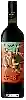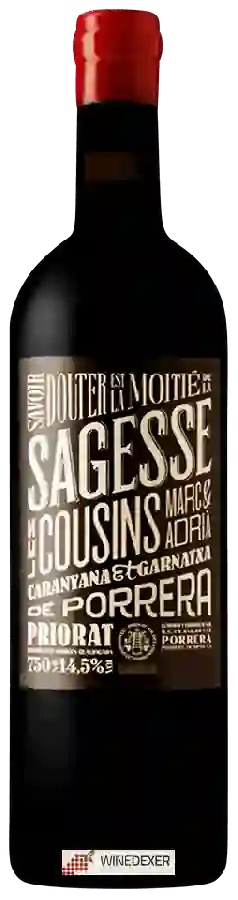
Winery Les Cousins Marc & AdriàSagesse
 Red wine


In the mouth this red wine is a powerful with a nice balance between acidity and tannins.
This wine generally goes well with poultry, beef or game (deer, venison).

Taste structure of the Sagesse from the Winery Les Cousins Marc & Adrià
Light | Bold | |
Smooth | Tannic | |
Dry | Sweet | |
Soft | Acidic |
In the mouth the Sagesse of Winery Les Cousins Marc & Adrià in the region of Catalogne is a powerful with a nice balance between acidity and tannins.
Wine flavors and olphactive analysis




On the nose the Sagesse of Winery Les Cousins Marc & Adrià in the region of Catalogne often reveals types of flavors of non oak, earth or microbio and sometimes also flavors of oak, spices or red fruit.
Food and wine pairings with Sagesse
Pairings that work perfectly with Sagesse



Original food and wine pairings with Sagesse

The Sagesse of Winery Les Cousins Marc & Adrià matches generally quite well with dishes of beef, lamb or game (deer, venison) such as recipes of boeuf lôc lac (cambodia), lamb mice confit and melting carrots or venison stew.
Details and technical informations about Winery Les Cousins Marc & Adrià's Sagesse.
Discover the grape variety: Pecorino
Structured, aromatic whites with firm acidity and an ample mouth, featuring aromas of citrus, yellow peach, aromatic herbs (sage, thyme), almond, white flowers and saline mineral notes. Fine length and ageing capacity. Star of Offida Pecorino DOCG in the Marche and Abruzzo Pecorino DOC, driving force behind the revival of great modern Adriatic whites. Native Italian grape rediscovered in the 1980s after near-disappearance.
Last vintages of this wine
The best vintages of Sagesse from Winery Les Cousins Marc & Adrià are 2014, 2009, 2012, 2011 and 2010.
Informations about the Winery Les Cousins Marc & Adrià
The Winery Les Cousins Marc & Adrià is one of of the world's greatest estates. It offers 4 wines for sale in the of Priorat to come and discover on site or to buy online.

The wine region of Priorat
Mythical Catalan terroir, DOCa (Spain's summit alongside Rioja). Powerful, concentrated reds with signature notes of candied black fruits (blackberry, black cherry), graphite, schist, garrigue, cocoa and liquorice, firm tannins and a mineral palate strung by the "llicorella" (black schist and quartz forcing roots down to 20 m). Old vines of Garnacha (roundness) and Cariñena (Samsó, structure). Exceptional ageing.
The wine region of Catalogne
Cradle of Cava (~95% of Spanish output, traditional method): Macabeo, Xarel-lo, Parellada trilogy, fine fruity bubble. Quality peak in Priorat DOCa: dense, mineral reds on llicorella (schist), old-vine Garnacha and Cariñena with black fruit, garrigue notes, firm tannins. Also Penedès, fleshy Montsant, sunny Empordà, Costers del Segre. Mediterranean.
The word of the wine: Wooded
A set of aromas brought about by ageing in barrels (usually oak). This can be pleasant when, in small doses, it brings a touch of spice, roast or vanilla to an already constructed ensemble. When the violent woodiness dominates the wine, it is quickly tiring. Easily identifiable aromatically, it is sought after (to the point of abuse) by the makers of coarse wines. New World manufacturers and, alas, some French winemakers use oak chips to impart the woody taste, which is tantamount to artificial flavoring.