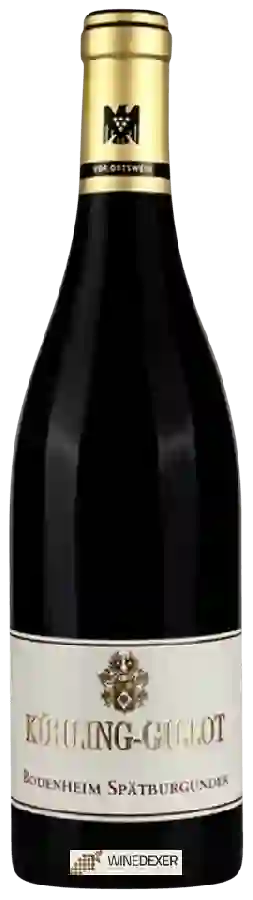
Winery Kühling-GillotBodenheim Spätburgunder
 Red wine


In the mouth this red wine is a with a nice freshness.
This wine generally goes well with poultry, beef or veal.

Taste structure of the Bodenheim Spätburgunder from the Winery Kühling-Gillot
Light | Bold | |
Smooth | Tannic | |
Dry | Sweet | |
Soft | Acidic |
In the mouth the Bodenheim Spätburgunder of Winery Kühling-Gillot in the region of Rheinhessen is a with a nice freshness.
Wine flavors and olphactive analysis



On the nose the Bodenheim Spätburgunder of Winery Kühling-Gillot in the region of Rheinhessen often reveals types of flavors of non oak, oak or spices and sometimes also flavors of red fruit.
Food and wine pairings with Bodenheim Spätburgunder
Pairings that work perfectly with Bodenheim Spätburgunder



Original food and wine pairings with Bodenheim Spätburgunder

The Bodenheim Spätburgunder of Winery Kühling-Gillot matches generally quite well with dishes of beef, veal or game (deer, venison) such as recipes of beef enchilladas au gratin, veal colombo or roast duck with cider sauce.
Details and technical informations about Winery Kühling-Gillot's Bodenheim Spätburgunder.
Discover the grape variety: Frühburgunder
Elegant, structured reds with a clear ruby hue, fine and smooth tannins and an airy palate with fresh acidity; signature aromas of red fruits (cherry, raspberry), forest floor, gentle spices and floral notes. Very early-ripening, contributing to great German reds with a Burgundian character. Grown mainly in Franken, Rheinhessen and Württemberg. Native German black grape, an early-ripening mutation of Pinot Noir.
Last vintages of this wine
The best vintages of Bodenheim Spätburgunder from Winery Kühling-Gillot are 2016, 0
Informations about the Winery Kühling-Gillot
The Winery Kühling-Gillot is one of of the world's great estates. It offers 88 wines for sale in the of Rheinhessen to come and discover on site or to buy online.

The wine region of Rheinhessen
71% white region: Riesling is king (5,000 ha), dry to off-dry, ripe yellow fruit, apple, citrus and fine saline minerality. Supple, floral Müller-Thurgau for everyday, the world's largest Silvaner plantation with herbaceous, straight notes. Historic cradle of off-sweet Liebfraumilch. Some supple reds (Dornfelder, Spätburgunder).
The word of the wine: Warm
A wine rich in alcohol whose power is expressed by an alcoholic nose and a burning sensation in the mouth.