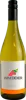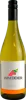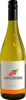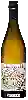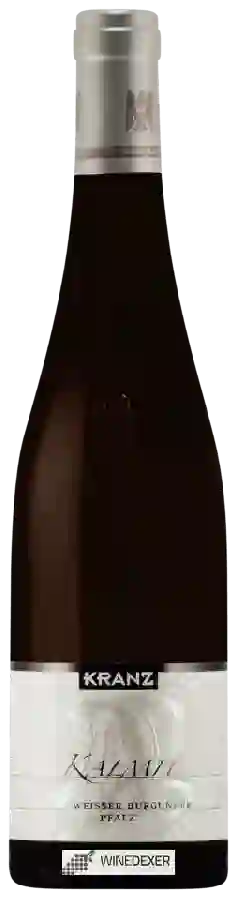
Winery KranzKalmit Weisser Burgunder
 White wine


In the mouth this white wine is a with a nice freshness.
This wine generally goes well with rich fish (salmon, tuna etc), shellfish or mild and soft cheese.
Taste structure of the Kalmit Weisser Burgunder from the Winery Kranz
Light | Bold | |
Dry | Sweet | |
Soft | Acidic |
In the mouth the Kalmit Weisser Burgunder of Winery Kranz in the region of Pfalz is a with a nice freshness.



Food and wine pairings with Kalmit Weisser Burgunder
Pairings that work perfectly with Kalmit Weisser Burgunder



Original food and wine pairings with Kalmit Weisser Burgunder

The Kalmit Weisser Burgunder of Winery Kranz matches generally quite well with dishes of rich fish (salmon, tuna etc), shellfish or mild and soft cheese such as recipes of salmon steaks with cream sauce, yakisoba (fried noodles) or savoyard fondue.
Details and technical informations about Winery Kranz's Kalmit Weisser Burgunder.
Discover the grape variety: Humagne rouge
It is a variety of Valle d'Aosta origin and, like Arvine, it is also found in Italy. In the past, it was cultivated in Savoy and registered in the official catalogue of wine grape varieties, list B, under the name of red humagne, but it is not related to white humagne. According to recent genetic analyses, the Swiss variety Cornalin du Valais is its father and Rèze its grandmother. It is also the grandson of the petit rouge d' Aoste.
Last vintages of this wine

The best vintages of Kalmit Weisser Burgunder from Winery Kranz are 2015, 0, 2014, 2018 and 2017.
Informations about the Winery Kranz
The Winery Kranz is one of of the world's greatest estates. It offers 47 wines for sale in the of Pfalz to come and discover on site or to buy online.

The wine region of Pfalz
Pfalz is a key wine producing region in western Germany, located between the Rhein/Rhine river and the low-lying Haardt mountain range (a natural continuation of the Alsatian Vosges). It covers a rectangle of land 45 miles (75km) Long and 15 miles (25km) wide. To the NorthLiesRheinhessen; to the South, the French border and Alsace. In terms of both quality and quantity, Pfalz is one of Germany's most important regions, and one which shows great promise for the future.
The word of the wine: Rimage
"Vintage", in Catalan. A natural sweet wine that is bottled early to preserve its fruitiness, as opposed to those aged in an oxidizing environment (see this word). Syn.: vintage (for maury, port).