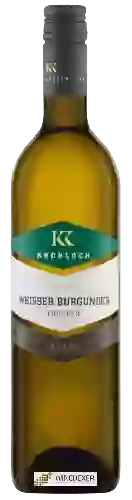
The Winery Knobloch of Rheinhessen

Winery Knobloch
The winery offers 47 different wines
3.6


Note - 1Note - 1Note - 1Note - 0.5Note - 0
Its wines get an average rating of 3.6.
It is ranked in the top 1224 of the estates of Rheinhessen.
It is located in Rheinhessen

The Winery Knobloch is one of the best wineries to follow in Rheinhessen.. It offers 47 wines for sale in of Rheinhessen to come and discover on site or to buy online.
Top Winery Knobloch wines

Looking for the best Winery Knobloch wines in Rheinhessen among all the wines in the region? Check out our tops of the best red, white or effervescent Winery Knobloch wines. Also find some food and wine pairings that may be suitable with the wines from this area. Learn more about the region and the Winery Knobloch wines with technical and enological descriptions.

The top white wines of Winery Knobloch

Food and wine pairings with a white wine of Winery Knobloch

How Winery Knobloch wines pair with each other generally quite well with dishes of rich fish (salmon, tuna etc), shellfish or mild and soft cheese such as recipes of pasta with tuna, garlic and lemon cream, cassolettes of scallops or savoyard fondue with ceps.

Organoleptic analysis of white wines of Winery Knobloch

In the mouth the white wine of Winery Knobloch. is a with a nice freshness.

The best vintages in the white wines of Winery Knobloch

  • 2019With an average score of 4.00/5
  • 2013With an average score of 4.00/5
  • 2016With an average score of 3.70/5
  • 0With an average score of 3.64/5
  • 2015With an average score of 3.55/5
  • 2018With an average score of 3.52/5

The grape varieties most used in the white wines of Winery Knobloch.

  • Weissburgunder
  • Bacchus
  • Grauburgunder
  • Riesling
  • Pinot Noir
  • Müller-Thurgau

Discovering the wine region of Rheinhessen

71% white region: Riesling is king (5,000 ha), dry to off-dry, ripe yellow fruit, apple, citrus and fine saline minerality. Supple, floral Müller-Thurgau for everyday, the world's largest Silvaner plantation with herbaceous, straight notes. Historic cradle of off-sweet Liebfraumilch. Some supple reds (Dornfelder, Spätburgunder).

Germany's largest vineyard (26,800 ha) between Mainz, Alzey and Worms, warm microclimate, limestone and loess soils. Marked qualitative renewal.

The top red wines of Winery Knobloch

Food and wine pairings with a red wine of Winery Knobloch

How Winery Knobloch wines pair with each other generally quite well with dishes of pasta, veal or pork such as recipes of lasagne with salmon, goat cheese and spinach, simple veal sauté or cantonese rice.

Organoleptic analysis of red wines of Winery Knobloch

On the nose the red wine of Winery Knobloch. often reveals types of flavors of red fruit, black fruit. In the mouth the red wine of Winery Knobloch. is a with a nice freshness.

The best vintages in the red wines of Winery Knobloch

  • 2013With an average score of 3.80/5
  • 2018With an average score of 3.70/5
  • 2016With an average score of 3.60/5
  • 0With an average score of 3.56/5
  • 2015With an average score of 3.49/5
  • 2014With an average score of 3.21/5

The grape varieties most used in the red wines of Winery Knobloch.

  • Spätburgunder
  • Dornfelder
  • Lemberger
  • Cabernet Mitos
  • Dunkelfelder
  • Regent

Discover the grape variety: Müller-Thurgau

Light, aromatic whites with a tender palate and moderate acidity, with muscat-like aromas of white flowers, apple, citrus, peach and honeyed notes. Made as easy dry whites, popular semi-dry wines and some sparkling cuvées. Widely planted in Germany (Rheinhessen, Baden), northern Italy (Alto Adige, Trentino), Austria, Switzerland, Hungary and Japan. Cross of riesling × madeleine royale created in 1882 by Hermann Müller in Geisenheim.

Discover other wineries and winemakers neighboring the Winery Knobloch

Planning a wine route in the of Rheinhessen? Here are the wineries to visit and the winemakers to meet during your trip in search of wines similar to Winery Knobloch.

Discover the grape variety: Dunkelfelder

Intensely coloured and supple reds with an inky, near-black robe, melted tannins and a fruity mouthfeel, with simple aromas of black fruits (blackberry, blackcurrant), cherry, plum and floral notes. A dye variety (red pulp) mainly used in blending to boost the colour of light reds (notably Pinot Noir) in Germany (Pfalz), Switzerland and England. A German hybrid created in 1939 at Geisenheim (Färbertraube × Pinot Noir).