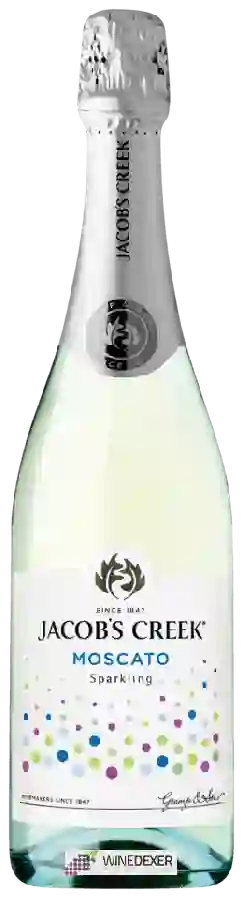
Winery Jacob's CreekSparkling Moscato
 Sparkling wine



This wine generally goes well with sweet desserts
Wine flavors and olphactive analysis



On the nose the Sparkling Moscato of Winery Jacob's Creek in the region of Australie du Sud-Est often reveals types of flavors of tropical, apples or peach and sometimes also flavors of pear, honey or earth.
Food and wine pairings with Sparkling Moscato
Pairings that work perfectly with Sparkling Moscato

Original food and wine pairings with Sparkling Moscato
The Sparkling Moscato of Winery Jacob's Creek matches generally quite well with dishes of sweet desserts such as recipes of homemade cookies.
Details and technical informations about Winery Jacob's Creek's Sparkling Moscato.
Discover the grape variety: Riesling italien
We do not know exactly where this grape variety comes from. It can be found in Austria, Romania, northern Italy, Croatia, Serbia, Hungary, Bulgaria, the Czech Republic, Slovakia, Russia, etc. It is practically unknown in France. In Spain, Borba is said to be identical to the Italian Riesling.
Last vintages of this wine
The best vintages of Sparkling Moscato from Winery Jacob's Creek are 2015, N.V., 2014, 2013 and 2012.
Informations about the Winery Jacob's Creek
The Winery Jacob's Creek is one of of the world's greatest estates. It offers 251 wines for sale in the of Australie du Sud-Est to come and discover on site or to buy online.

The wine region of Australie du Sud-Est
South East Australia is a geographical indication (GI) covering the entire south-eastern third of Australia. The western boundary of this area extends 2,000 kilometres (1,250 miles) across the Australian continent from the Pacific coast of Queensland to the Southern Ocean coast of South Australia. This vast wine 'super zone' effectively encompasses all the major Australian wine regions outside Western Australia. Rainforest, mountain ranges, scrubland, desert and Dry riverbeds occupy the majority of the land in the South East Australian area.
The word of the wine: Pruine
A thin, fluffy film that covers the surface of the grape. It makes the berry impermeable and contains the indigenous yeasts necessary for the fermentation of the must.