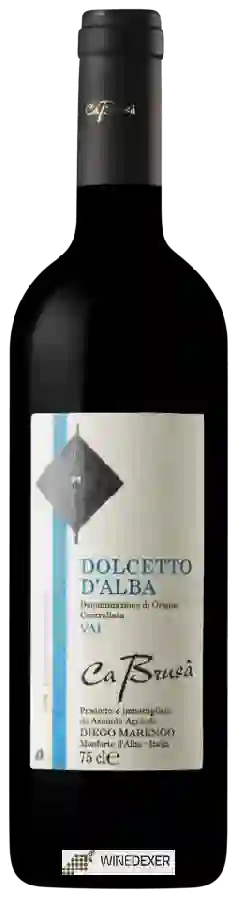
Winery Cà BrusàVai Dolcetto d'Alba
 Red wine



This wine generally goes well with pork, mild and soft cheese or mushrooms.
Food and wine pairings with Vai Dolcetto d'Alba
Pairings that work perfectly with Vai Dolcetto d'Alba



Original food and wine pairings with Vai Dolcetto d'Alba
The Vai Dolcetto d'Alba of Winery Cà Brusà matches generally quite well with dishes of pork, mushrooms or mild and soft cheese such as recipes of homemade burger, turkey leg in a pressure cooker or tomato and goat cheese quiche.
Details and technical informations about Winery Cà Brusà's Vai Dolcetto d'Alba.
Discover the grape variety: Malvoisie de Toscane
It was cultivated in ancient times and is believed to be of Greek origin. In Italy, associated with Trebbiano Toscano, it was used to produce the famous Chianti: these two white varieties are no longer part of the vineyard. In France, Tuscan Malvasia is practically unknown. It should be noted that many grape varieties have "malvasia" as a synonym, so confusion between them is always possible.
Last vintages of this wine
The best vintages of Vai Dolcetto d'Alba from Winery Cà Brusà are 2014, 2015, 0, 2016
Informations about the Winery Cà Brusà
The Winery Cà Brusà is one of of the world's greatest estates. It offers 15 wines for sale in the of Australie du Sud to come and discover on site or to buy online.

The wine region of Australie du Sud
SouthAustralia is one of Australia's six states, located (as the name suggests) in the south of the vast island continent. It's the engine room of the Australian wine industry, responsible for about half of the country's total production each year. But there's more to the region than quantity - countless high-quality wines are produced here, most from the region's signature Grape, Shiraz. These include such fine, collectible wines as Penfolds Grange, Henschke Hill of Grace, Torbreck The Laird and d'Arenberg The Dead Arm.
The word of the wine: Climate
Term used in Burgundy to designate a locality. The most famous climats are subject to specific recognition and constitute the first growths.