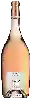
Winery Henri de RichemerGrenache - Cinsault Rosé
 Pink wine
This wine generally goes well with
Details and technical informations about Winery Henri de Richemer's Grenache - Cinsault Rosé.
Discover the grape variety: Carmenère
Carménère is a grape variety of Bordeaux origin. It is the result of a cross between Cabernet Franc and Gros Cabernet. In France, it occupies only about ten hectares, but it is also grown in Chile, Peru, the Andes, California, Italy and Argentina. The leaves of the carmenere are shiny and revolute. Its berries are round and medium-sized. Carménère is susceptible to grey rot, especially in wet autumn. It can also be exposed to the risk of climatic coulure, which is why it is important to grow it on poor soil and in warm areas. Carménère is associated with an average second ripening period. This variety has only one approved clone, 1059. It can be vinified with Cabernet Sauvignon and Merlot. It produces a rich, highly coloured wine, which acquires character when combined with other grape varieties.
Informations about the Winery Henri de Richemer
The Winery Henri de Richemer is one of of the world's great estates. It offers 42 wines for sale in the of Provence to come and discover on site or to buy online.

The wine region of Provence
Provence is a wine region in the far southeast of France, best known for the quality (and quantity) of its rosé wines and for its Warm, mild Climate. The modernization that is taking place in many of the traditional wine regions of southern France has not yet taken place to the same extent in Provence, but there are Clear signs of change. The region's Grape varieties, in particular, have come under scrutiny in recent decades. Traditional varieties such as Carignan, Barbaroux (Barbarossa from Sardinia) and Calitor are being replaced by more commercially viable varieties such as Grenache, Syrah and even Cabernet Sauvignon.
The word of the wine: Bâtonnage
A very old technique that has come back into fashion in modern oenology, which consists of shaking the white wine in the barrels at the end of fermentation, or after fermentation, with a stick or a flail, in order to suspend the fine lees composed of yeasts at the end of their activity. This process is sometimes used for red wines.