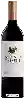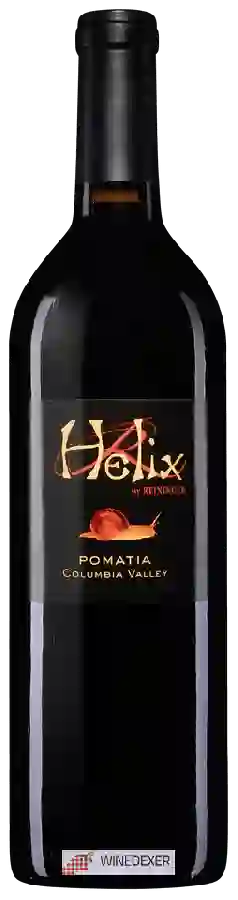
Winery Helix by ReiningerPomatia
 Red wine



This wine is a blend of 3 varietals which are the Cabernet franc, the Cabernet-Sauvignon and the Merlot.
In the mouth this red wine is a powerful with a nice balance between acidity and tannins.
This wine generally goes well with poultry, beef or veal.

Taste structure of the Pomatia from the Winery Helix by Reininger
Light | Bold | |
Smooth | Tannic | |
Dry | Sweet | |
Soft | Acidic |
In the mouth the Pomatia of Winery Helix by Reininger in the region of Washington is a powerful with a nice balance between acidity and tannins.
Wine flavors and olphactive analysis





On the nose the Pomatia of Winery Helix by Reininger in the region of Washington often reveals types of flavors of non oak, earth or oak and sometimes also flavors of spices, red fruit or black fruit.
Food and wine pairings with Pomatia
Pairings that work perfectly with Pomatia



Original food and wine pairings with Pomatia

The Pomatia of Winery Helix by Reininger matches generally quite well with dishes of beef, pasta or veal such as recipes of roast pork with pineapple, makroud or veal liver in vinegar.
Details and technical informations about Winery Helix by Reininger's Pomatia.
Discover the grape variety: Cabernet franc
Supple, fragrant reds with fine tannins and vibrant freshness, showing raspberry, violet, green pepper, pencil lead and gentle spice aromas. Star of the Loire as a single variety (Chinon, Bourgueil, Saumur-Champigny) and of the right bank of Bordeaux in blends (Cheval Blanc at 60%). Also in semi-dry Anjou rosés. A historic Bordeaux variety, parent of Cabernet-Sauvignon, Merlot and Carmenère.
Last vintages of this wine
The best vintages of Pomatia from Winery Helix by Reininger are 2009, 2005, 2011, 2007 and 2010.
Informations about the Winery Helix by Reininger
The Winery Helix by Reininger is one of of the world's greatest estates. It offers 16 wines for sale in the of Columbia Valley to come and discover on site or to buy online.

The wine region of Columbia Valley
Cradle of Washington State's great reds. Dense, structured Cabernet Sauvignon (blackcurrant, blackberry, graphite, firm tannins), round velvety Merlot, signature Syrah with peppery notes, black olive and deep black fruit. Also precise whites: balanced Chardonnay, taut fruity Riesling with peach notes. Semi-desert vineyard of 24,300 ha sheltered by the Cascades, loess soils over basalt, strong temperature swings.
The wine region of Washington
2nd US producer by volume, on the arid, sunny Columbia Valley. Star Cabernet Sauvignon (~60% of reds): powerful and structured with signature notes of blackcurrant, blackberry, cedar, dry herbs and graphite, firm tannins. Fleshy, peppery Syrah (black fruits, smoked meat). Round, fruity Merlot, historic mineral Riesling (dry and off-dry), precise Chardonnay and ample Sémillon.
The word of the wine: Tanin
A natural compound contained in the skin of the grape, the seed or the woody part of the bunch, the stalk. The maceration of red wines allows the extraction of tannins, which give the texture, the solidity and also the mellowness when the tannins are "ripe". The winemaker seeks above all to extract the tannins from the skin, the ripest and most noble. The tannins of the seed or stalk, which are "greener", especially in average years, give the wine hardness and astringency. The wines of Bordeaux (based on Cabernet and Merlot) are full of tannins, those of Burgundy much less so, with Pinot Noir containing little.