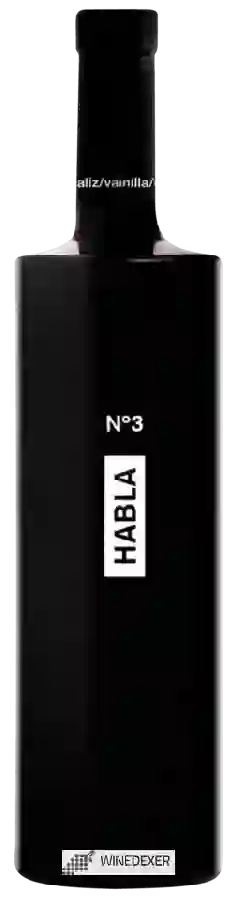
Winery HablaNo. 3
 Red wine


In the mouth this red wine is a powerful.
This wine generally goes well with poultry, beef or veal.
The No. 3 of the Winery Habla is in the top 50 of wines of Estrémadure.

Taste structure of the No. 3 from the Winery Habla
Light | Bold | |
Smooth | Tannic | |
Dry | Sweet | |
Soft | Acidic |
In the mouth the No. 3 of Winery Habla in the region of Estrémadure is a powerful.
Food and wine pairings with No. 3
Pairings that work perfectly with No. 3



Original food and wine pairings with No. 3

The No. 3 of Winery Habla matches generally quite well with dishes of beef, pasta or veal such as recipes of wild boar with honey, pasta bolognese or bocconcini (veal rolls with ham and comté).
Details and technical informations about Winery Habla's No. 3.
Discover the grape variety: Gros Manseng
Structured, aromatic whites with lively acidity and an ample mouth, featuring intense aromas of exotic fruits (pineapple, mango, passion fruit), ripe citrus, yellow peach, white flowers, honey and sweet spices. Made as nervy modern dry wines (Jurançon sec AOC, IGP Côtes de Gascogne) and sumptuous passerillage sweet wines (Jurançon AOC, Pacherenc du Vic-Bilh AOC). Late-ripening native grape of Béarn, the productive sibling of Petit Manseng.
Last vintages of this wine

The best vintages of No. 3 from Winery Habla are 2015, 2008, 2010, 2013 and 2014.
Informations about the Winery Habla
The Winery Habla is one of of the world's great estates. It offers 48 wines for sale in the of Estrémadure to come and discover on site or to buy online.

The wine region of Estrémadure
Autonomous community of western Spain, the 2nd largest national vineyard (~87,000 ha) with excellent value for money. Tempranillo signature in red: round and accessible with signature notes of ripe cherry, plum, soft vanilla, leather and a spicy touch, supple tannins. Sun-drenched Garnacha, colourful Bobal, firm Cabernet complete the line-up. Vivid Cayetana and Pardina whites (citrus, flowers).
The word of the wine: Cuvée
Often followed by a name that allows for recognition and identification, the word "cuvée" designates a specific wine within the production of a winemaker. This wine is characterized by a specific grape variety, a type of maturation and an organoleptic profile. All the vintages of a domain constitute a range.