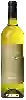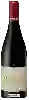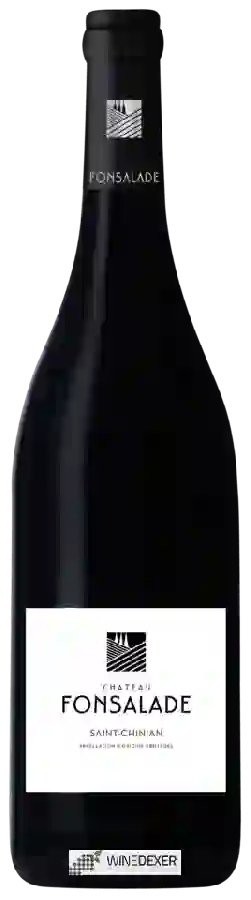
Château FonsaladeSaint-Chinian Rouge
 Red wine
In the mouth this red wine is a powerful with a nice balance between acidity and tannins.
This wine generally goes well with beef, veal or pasta.

Taste structure of the Saint-Chinian Rouge from the Château Fonsalade
Light | Bold | |
Smooth | Tannic | |
Dry | Sweet | |
Soft | Acidic |
In the mouth the Saint-Chinian Rouge of Château Fonsalade in the region of Languedoc-Roussillon is a powerful with a nice balance between acidity and tannins.
Food and wine pairings with Saint-Chinian Rouge
Pairings that work perfectly with Saint-Chinian Rouge



Original food and wine pairings with Saint-Chinian Rouge
The Saint-Chinian Rouge of Château Fonsalade matches generally quite well with dishes of beef, pasta or veal such as recipes of pot-au-feu, pasta with tuna or chicken breast with curry and mushrooms.
Details and technical informations about Château Fonsalade's Saint-Chinian Rouge.
Discover the grape variety: Rotberger
Fresh, fruity reds and rosés best drunk young, with a light ruby to deep pink robe, silky tannins and an airy palate with fresh acidity, showing signature aromas of red fruits (cherry, raspberry) and floral notes. Also a base for sparkling wines. Grown in Germany and Canada, used mainly for Weissherbst (quality German rosés) and sparkling wines. German black grape obtained in 1928 at Geisenheim (Riesling × Trollinger).
Informations about the Château Fonsalade
The Château Fonsalade is one of of the world's greatest estates. It offers 9 wines for sale in the of Saint-Chinian to come and discover on site or to buy online.

The wine region of Saint-Chinian
Languedoc cru between Beziers and Saint-Pons, signature dual terroir. Fleshy Mediterranean reds with notes of black fruit (blackberry, black cherry), garrigue, pepper, liquorice and spice, firm tannins and a sun-drenched palate. Northern schists: fruitier, smokier profile. Southern clay-limestone: more structured wines.
The wine region of Languedoc-Roussillon
Largest single French vineyard, dominated by sunny, generous reds. Spicy Syrah, candied Grenache (ripe fruit, garrigue), structured Carignan, deep Mourvèdre, supple Cinsault. Stars: structured Corbières, Minervois, Faugères, Saint-Chinian; round Côtes-du-Roussillon. Legendary vins doux naturels: Banyuls and Maury (fortified Grenache) with notes of cocoa, fig, prune.
The word of the wine: Oenologist
Specialist in wine-making techniques. It is a profession and not a passion: one can be an oenophile without being an oenologist (and the opposite too!). Formerly attached to the Faculty of Pharmacy, oenology studies have become independent and have their own university course. Learning to make wine requires a good chemical background but also, increasingly, a good knowledge of the plant. Some oenologists work in laboratories (analysis). Others, the consulting oenologists, work directly in the properties.