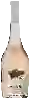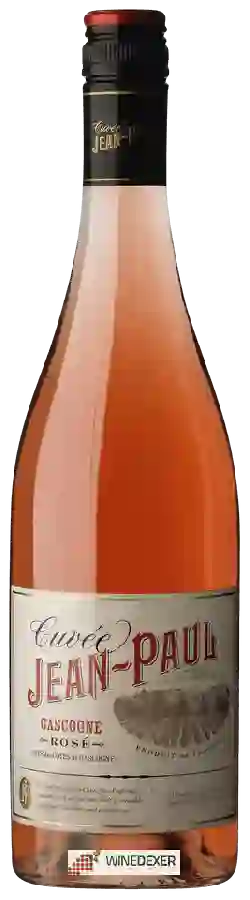
Winery Cuvée Jean-PaulGascogne Rosé
 Pink wine



This wine is a blend of 3 varietals which are the Cabernet franc, the Tannat and the Merlot.
This wine generally goes well with pork, poultry or beef.

Wine flavors and olphactive analysis


On the nose the Gascogne Rosé of Winery Cuvée Jean-Paul in the region of South West often reveals types of flavors of cream, grapefruit or peach and sometimes also flavors of strawberries, raspberry or melon.
Food and wine pairings with Gascogne Rosé
Pairings that work perfectly with Gascogne Rosé



Original food and wine pairings with Gascogne Rosé


The Gascogne Rosé of Winery Cuvée Jean-Paul matches generally quite well with dishes of beef, pork or game (deer, venison) such as recipes of beef in white wine, pasta "carbonara" à la française or wild boar bourguignon.
Details and technical informations about Winery Cuvée Jean-Paul's Gascogne Rosé.
Discover the grape variety: Cabernet franc
Supple, fragrant reds with fine tannins and vibrant freshness, showing raspberry, violet, green pepper, pencil lead and gentle spice aromas. Star of the Loire as a single variety (Chinon, Bourgueil, Saumur-Champigny) and of the right bank of Bordeaux in blends (Cheval Blanc at 60%). Also in semi-dry Anjou rosés. A historic Bordeaux variety, parent of Cabernet-Sauvignon, Merlot and Carmenère.
Last vintages of this wine
The best vintages of Gascogne Rosé from Winery Cuvée Jean-Paul are 2018, 2017, 2016, 2019 and 2010.
Informations about the Winery Cuvée Jean-Paul
The Winery Cuvée Jean-Paul is one of of the world's greatest estates. It offers 5 wines for sale in the of Gascogne to come and discover on site or to buy online.

The wine region of Gascogne
Gers South-West IGP on the Armagnac territory, 90% lively, aromatic whites. Signature Colombard (~50%): explosive notes of citrus, grapefruit, exotic fruits, box and a floral touch, taut and thirst-quenching palate — the summer aperitif at gentle prices. More neutral Ugni Blanc (also Armagnac base), herbaceous Sauvignon, more ample Gros and Petit Manseng (yellow fruits, honey). Oceanic temperate climate on "boulbènes" soils.
The wine region of South West
French mosaic of strong identities south of Bordeaux. Cahors and its Malbec ("black wine"): deep reds with notes of blackberry, plum, violet, tobacco and cocoa, firm tannins. Madiran and its dense, age-worthy Tannat. Jurançon whites: golden sweet (apricot, honey, pineapple) and lively dry from Petit Manseng.
The word of the wine: Terroir
Strictly speaking, the notion of terroir corresponds to the geological characteristics of a vineyard. However, when we talk about terroir, we take into account the soil, the climate (even the microclimate), the flora, the fauna, and the human factor that characterizes the practices that make up the art of the craft.