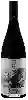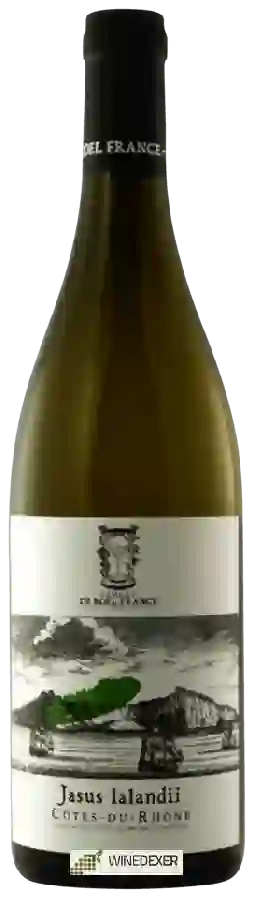
Winery Famille de Boel FranceJasus Lalandii Cote du Rhone Blanc
 White wine


In the mouth this white wine is a powerful with a nice freshness.
This wine generally goes well with pork, poultry or rich fish (salmon, tuna etc).
Taste structure of the Jasus Lalandii Cote du Rhone Blanc from the Winery Famille de Boel France
Light | Bold | |
Dry | Sweet | |
Soft | Acidic |
In the mouth the Jasus Lalandii Cote du Rhone Blanc of Winery Famille de Boel France in the region of Rhone Valley is a powerful with a nice freshness.
Wine flavors and olphactive analysis

On the nose the Jasus Lalandii Cote du Rhone Blanc of Winery Famille de Boel France in the region of Rhone Valley often reveals types of flavors of citrus, peach or tree fruit and sometimes also flavors of citrus fruit.
Food and wine pairings with Jasus Lalandii Cote du Rhone Blanc
Pairings that work perfectly with Jasus Lalandii Cote du Rhone Blanc



Original food and wine pairings with Jasus Lalandii Cote du Rhone Blanc


The Jasus Lalandii Cote du Rhone Blanc of Winery Famille de Boel France matches generally quite well with dishes of pork, rich fish (salmon, tuna etc) or mature and hard cheese such as recipes of rabbit with prunes, pan-fried salmon with lemon and dill sauce or cheese soufflé omelette.
Details and technical informations about Winery Famille de Boel France's Jasus Lalandii Cote du Rhone Blanc.
Discover the grape variety: Cabernet-Mitos
An intraspecific cross between Cabernet Sauvignon and Dyer du Cher obtained in 1970 in Weinsberg, Germany. It can be found in Germany, Switzerland, etc. and is virtually unknown in France.
Last vintages of this wine
The best vintages of Jasus Lalandii Cote du Rhone Blanc from Winery Famille de Boel France are 2018
Informations about the Winery Famille de Boel France
The Winery Famille de Boel France is one of of the world's greatest estates. It offers 11 wines for sale in the of Côtes-du-Rhône to come and discover on site or to buy online.

The wine region of Côtes-du-Rhône
The wine region of Côtes-du-Rhône is located in the region of Rhône méridional of Rhone Valley of France. Wineries and vineyards like the Château de Beaucastel or the Chateau de Fonsalette produce mainly wines red, white and pink. The most planted grape varieties in the region of Côtes-du-Rhône are Mourvèdre, Viognier and Marsanne, they are then used in wines in blends or as a single variety. On the nose of Côtes-du-Rhône often reveals types of flavors of pineapple, red plum or sour cherry and sometimes also flavors of truffle, juniper or clove.
The wine region of Rhone Valley
The Rhone Valley is a key wine-producing region in Southeastern France. It follows the North-south course of the Rhône for nearly 240 km, from Lyon to the Rhône delta (Bouches-du-Rhône), near the Mediterranean coast. The Length of the valley means that Rhône wines are the product of a wide variety of soil types and mesoclimates. The viticultural areas of the region cover such a distance that there is a widely accepted division between its northern and southern parts.
The word of the wine: Warm
A wine rich in alcohol whose power is expressed by an alcoholic nose and a burning sensation in the mouth.