The Winery Etienne Bailly of Beaujolais
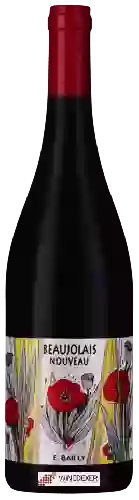
Winery Etienne Bailly
The winery offers 8 different wines
3.7


Note - 1Note - 1Note - 1Note - 0.5Note - 0
Its wines get an average rating of 3.7.
It is ranked in the top 1154 of the estates of Beaujolais.
It is located in Beaujolais

The Winery Etienne Bailly is one of the best wineries to follow in Beaujolais.. It offers 8 wines for sale in of Beaujolais to come and discover on site or to buy online.
Top Winery Etienne Bailly wines

Looking for the best Winery Etienne Bailly wines in Beaujolais among all the wines in the region? Check out our tops of the best red, white or effervescent Winery Etienne Bailly wines. Also find some food and wine pairings that may be suitable with the wines from this area. Learn more about the region and the Winery Etienne Bailly wines with technical and enological descriptions.

The top red wines of Winery Etienne Bailly

Food and wine pairings with a red wine of Winery Etienne Bailly

How Winery Etienne Bailly wines pair with each other generally quite well with dishes of pasta, veal or pork such as recipes of cannelloni with salmon and spinach, gigolette of rabbit or the tartiflette wrap.

Organoleptic analysis of red wines of Winery Etienne Bailly

On the nose the red wine of Winery Etienne Bailly. often reveals types of flavors of strawberries, red fruit or cherry and sometimes also flavors of cranberry, oak or spices.

The best vintages in the red wines of Winery Etienne Bailly

  • 2018With an average score of 3.90/5
  • 2017With an average score of 3.80/5
  • 2015With an average score of 3.80/5
  • 0With an average score of 3.70/5
  • 2016With an average score of 3.66/5
  • 2019With an average score of 3.50/5

The grape varieties most used in the red wines of Winery Etienne Bailly.

  • Gamay
  • Pinot Noir

Discovering the wine region of Beaujolais

Beaujolais is an important wine region in eastern France, famous for its vibrant, Fruity red wines made from Gamay. It is located immediately South of Burgundy, of which it is sometimes considered a Part, although it is in the administrative region of Rhône. The extensive plantings of Gamay in this region make Beaujolais one of the few regions in the world that is so concentrated on a single Grape variety. Pinot Noir is used in small quantities in red and rosé wines, but in the name of regional identity, it is being phased out and will only be allowed until the 2015 harvest.

Although best known for its red wines, the region also produces white Beaujolais Blanc, from Chardonnay and Aligote. These two white wine varieties are also sometimes used in local red wines, in which they can make up to 15% of the Final blend. There are several forms of Beaujolais red wine: standard Beaujolais (including Beaujolais Supérieur), Beaujolais Villages and the Young, characterful Beaujolais Nouveau. The highest quality wines of the region are those of the ten Beaujolais crus - ten wine regions Long recognized as the best in the region.

Discover other wineries and winemakers neighboring the Winery Etienne Bailly

Planning a wine route in the of Beaujolais? Here are the wineries to visit and the winemakers to meet during your trip in search of wines similar to Winery Etienne Bailly.

Discover the grape variety: Mondeuse blanche

Haute-Savoie finds in Mondeuse blanche one of the oldest grape varieties planted in its vineyards. It can be found throughout Savoie and Ain, although its cultivation is not very well developed. Barely 5 hectares of vineyards are planted with this variety. It is known by other names such as savouette, dongine, couilleri or aigre blanc. Mondeuse blanche can be recognized by the downy appearance of its young shoots bearing very tan leaves, reminiscent of spider webs. The leaf blade tends to lose its tan appearance as it ages, while the 5 lobes are clearly defined. Mondeuse blanche produces bunches of grapes that give a wine with good acidity and a long shelf life, which can be kept for up to thirty years. They appear compact, cylindrical and winged. The juicy, sweet and crunchy berries ripen in the second late season. The golden yellow or green skin is quite strong, covering an ovoid or spherical fruit of medium size.