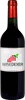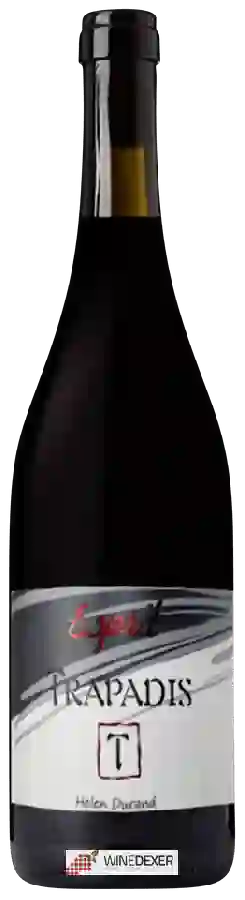
Domaine du TrapadisEsprit
 Red wine



This wine generally goes well with beef and mature and hard cheese.

Wine flavors and olphactive analysis

On the nose the Esprit of Domaine du Trapadis in the region of Pays d'Oc often reveals types of flavors of red fruit.
Food and wine pairings with Esprit
Pairings that work perfectly with Esprit


Original food and wine pairings with Esprit
The Esprit of Domaine du Trapadis matches generally quite well with dishes of beef or mature and hard cheese such as recipes of shepherd's pie (potatoes, beef, carrots, bacon) or beaufort pie.
Details and technical informations about Domaine du Trapadis's Esprit.
Discover the grape variety: Fogoneu
Light, fruity reds with a clear ruby robe, supple tannins and a light palate with moderate acidity, featuring signature aromas of red fruits (cherry, strawberry), Mediterranean herbs and notes of the insular maquis. Airy profile. Traditional component of Pla i Llevant DO blends in Majorca, contributing to the typicity of Balearic island wines. Spanish autochthonous black variety from the Balearic Islands, grown mainly in Majorca.
Last vintages of this wine
The best vintages of Esprit from Domaine du Trapadis are 2014, 2018, 2017, 2015 and 2016.
Informations about the Domaine du Trapadis
The Domaine du Trapadis is one of of the world's greatest estates. It offers 22 wines for sale in the of Vin de Pays to come and discover on site or to buy online.

The wine region of Vin de Pays
Intermediate category between AOC and Vin de France (renamed IGP in 2009), 27% of national volume. Accessible, expressive wines defined by their grape: opulent Chardonnay, lively Sauvignon, round Merlot, peppery Syrah, floral Viognier with apricot. 76 IGP in France at 3 scales: regional (Pays d'Oc, Méditerranée, Val de Loire), departmental or local. Flexible rules, wide range of permitted grapes, free grape and vintage labelling.
The wine region of Pays d'Oc
The single-grape IGP par excellence: modern, accessible, frank and fruity wines, the popular signature of the Midi. Spicy Syrah reds (pepper, blackberry), round Merlot, structured Cabernet, generous Grenache, supple Cinsault. Crisp, tangy rosés. Opulent Chardonnay whites, lively Sauvignon, floral, apricoty Viognier.
The word of the wine: Champagne rosé
Often obtained by adding red wines (from Champagne), it is even the only vineyard where this practice is allowed. Some producers prefer the practice used in other regions, i.e. a short maceration to extract sufficient colouring matter. This results in winey rosés for meals. Elegant aperitif rosé is more often made from red wine coloured Chardonnay. Rosés can be vintage or non vintage.