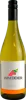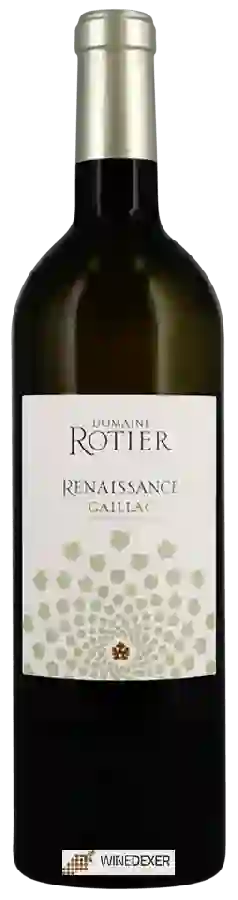
Domaine RotierRenaissance Blanc
 White wine



This wine generally goes well with vegetarian, rich fish (salmon, tuna etc) or shellfish.

Wine flavors and olphactive analysis





On the nose the Renaissance Blanc of Domaine Rotier in the region of South West often reveals types of flavors of oaky, cheese or honey and sometimes also flavors of non oak, earth or microbio.
Food and wine pairings with Renaissance Blanc
Pairings that work perfectly with Renaissance Blanc



Original food and wine pairings with Renaissance Blanc
The Renaissance Blanc of Domaine Rotier matches generally quite well with dishes of rich fish (salmon, tuna etc), shellfish or vegetarian such as recipes of sublime salmon (stuffed salmon), magic marinade (for shrimps, scallops, fish...) or tuna, pepper and tomato quiche.
Details and technical informations about Domaine Rotier's Renaissance Blanc.
Discover the grape variety: Rondinella
Light, fruity reds with a pale robe, discreet tannins and fresh acidity, showing aromas of red cherry, wild strawberry, gentle spice and herbal notes. A faithful companion to Corvina in the typical Valpolicella blends: fresh, gulpable Bardolino DOC, Valpolicella DOC, concentrated Amarone DOCG and sweet Recioto DOCG. A productive autochthonous variety from Veneto.
Last vintages of this wine
The best vintages of Renaissance Blanc from Domaine Rotier are 2012, 2009, 2010, 2013 and 2011.
Informations about the Domaine Rotier
The Domaine Rotier is one of of the world's greatest estates. It offers 14 wines for sale in the of Gaillac to come and discover on site or to buy online.

The wine region of Gaillac
Millennia-old South-West mosaic (banks of the Tarn) with rare native grapes: Mauzac reigns in whites — dry, pearled or sweet with notes of apple, pear, honey and white flowers, signature freshness. Ample Loin-de-l'œil and Ondenc complement. Duras in spicy, peppery reds, fleshy Braucol (Fer Servadou) (blackcurrant, raspberry, blackberry, structured tannins) and Syrah in blends. Iconic ancestral-method Gaillac sparkling.
The wine region of South West
French mosaic of strong identities south of Bordeaux. Cahors and its Malbec ("black wine"): deep reds with notes of blackberry, plum, violet, tobacco and cocoa, firm tannins. Madiran and its dense, age-worthy Tannat. Jurançon whites: golden sweet (apricot, honey, pineapple) and lively dry from Petit Manseng.
The word of the wine: Tired
Wine that is too old, faded or has suffered from handling such as racking or bottling. In the first case it is too late, in the second case the wine must be put to rest for a few weeks in the cellar.