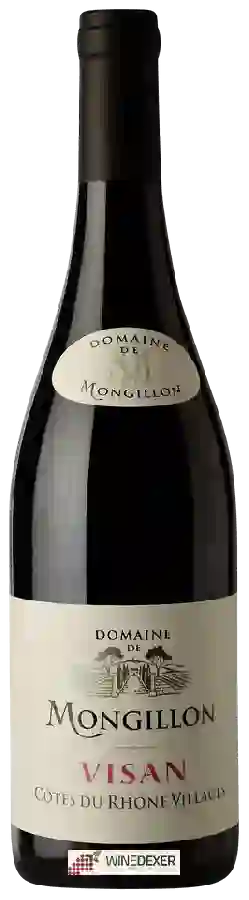
Domaine de MongillonCôtes du Rhône Villages 'Visan'
 Red wine



In the mouth this red wine is a powerful with a nice freshness.
This wine generally goes well with beef, game (deer, venison) or lamb.
The Côtes du Rhône Villages 'Visan' of the Domaine de Mongillon is in the top 70 of wines of Côtes-du-Rhône-Villages 'Visan'.
Taste structure of the Côtes du Rhône Villages 'Visan' from the Domaine de Mongillon
Light | Bold | |
Smooth | Tannic | |
Dry | Sweet | |
Soft | Acidic |
In the mouth the Côtes du Rhône Villages 'Visan' of Domaine de Mongillon in the region of Rhone Valley is a powerful with a nice freshness.
Wine flavors and olphactive analysis


On the nose the Côtes du Rhône Villages 'Visan' of Domaine de Mongillon in the region of Rhone Valley often reveals types of flavors of cherry, strawberries or vanilla and sometimes also flavors of non oak, oak or spices.
Food and wine pairings with Côtes du Rhône Villages 'Visan'
Pairings that work perfectly with Côtes du Rhône Villages 'Visan'



Original food and wine pairings with Côtes du Rhône Villages 'Visan'
The Côtes du Rhône Villages 'Visan' of Domaine de Mongillon matches generally quite well with dishes of beef, lamb or game (deer, venison) such as recipes of beef tagliata with truffle oil, lamb with masalé sauce and rice or rabbit with mustard in foil.
Details and technical informations about Domaine de Mongillon's Côtes du Rhône Villages 'Visan'.
Discover the grape variety: Concord
It is the result of a seedling planted in the United States, around 1840, recovered near the Concord River, a small river located east of Massachusetts. According to genetic analysis, it is an interspecific cross between the catawba and a vitis labrusca. Concord was for a long time the main variety cultivated in North America. It was introduced into Europe at the beginning of the 19th century, in France at the beginning of the phylloxera crisis, but was not widely propagated. It could be found in the Valleraugue region (Gard) at the foot of Mont Aigoual, in the Ardèche (our photos), etc. Today, it exists only as an isolated strain that can sometimes be found on the edge of a slope, which was our case. Through various and numerous crosses, it has been used to obtain some rootstocks and direct producer hybrids, which have now almost all disappeared.
Last vintages of this wine
The best vintages of Côtes du Rhône Villages 'Visan' from Domaine de Mongillon are 2013, 2017, 2015, 2014 and 2016.
Informations about the Domaine de Mongillon
The Domaine de Mongillon is one of of the world's greatest estates. It offers 4 wines for sale in the of Côtes-du-Rhône-Villages 'Visan' to come and discover on site or to buy online.

The wine region of Côtes-du-Rhône-Villages 'Visan'
The wine region of Côtes-du-Rhône-Villages 'Visan' is located in the region of Côtes-du-Rhône-Villages of Rhone Valley of France. Wineries and vineyards like the Domaine La Florane or the Domaine La Florane produce mainly wines red, white and pink. The most planted grape varieties in the region of Côtes-du-Rhône-Villages 'Visan' are Mourvèdre, Viognier and Roussanne, they are then used in wines in blends or as a single variety. On the nose of Côtes-du-Rhône-Villages 'Visan' often reveals types of flavors of cherry, raspberry or tree fruit and sometimes also flavors of blackberry, red fruit or strawberries.
The wine region of Rhone Valley
The Rhone Valley is a key wine-producing region in Southeastern France. It follows the North-south course of the Rhône for nearly 240 km, from Lyon to the Rhône delta (Bouches-du-Rhône), near the Mediterranean coast. The Length of the valley means that Rhône wines are the product of a wide variety of soil types and mesoclimates. The viticultural areas of the region cover such a distance that there is a widely accepted division between its northern and southern parts.
The word of the wine: Rootstock
American vine on which a French vine is grafted. This is the consequence of the phylloxera that destroyed the vineyard at the end of the 19th century: after much trial and error, it was discovered that the "pest" spared the roots of the American vines, and the technique became widespread.