The Domaine de la Vieille Julienne of Rhône méridional of Rhone Valley
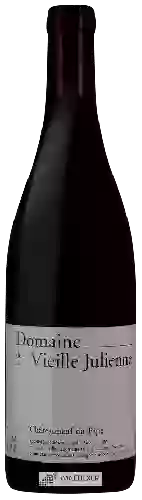
The Domaine de la Vieille Julienne is one of the world's great estates. It offers 11 wines for sale in of Rhône méridional to come and discover on site or to buy online.
Looking for the best Domaine de la Vieille Julienne wines in Rhône méridional among all the wines in the region? Check out our tops of the best red, white or effervescent Domaine de la Vieille Julienne wines. Also find some food and wine pairings that may be suitable with the wines from this area. Learn more about the region and the Domaine de la Vieille Julienne wines with technical and enological descriptions.
How Domaine de la Vieille Julienne wines pair with each other generally quite well with dishes of lamb, pork or poultry such as recipes of sweet and sour braised leg of lamb, stuffed eggplant (with vegetables or mixed) or coconut chicken.
On the nose the red wine of Domaine de la Vieille Julienne. often reveals types of flavors of cherry, oaky or smoke and sometimes also flavors of earthy, blackberry or blueberry. In the mouth the red wine of Domaine de la Vieille Julienne. is a powerful with a nice balance between acidity and tannins.
Côtes du Rhône is a regional appellation in the Rhône Valley in eastern France. It applies to red, rosé and white wines, and includes more than 170 villages. The area follows the course of the Rhône southward for 125 miles (200 km) from Saint-Cyr-sur-le-Rhône to Avignon. A small portion of the wines in the appellation are white wines.
However, the classic Côtes du Rhône wine is a blend of Fruity, medium-weight reds made from Grenache, Syrah and Mourvèdre. The Côtes du Rhône appellation was introduced in November 1937. Its purpose was to give a general title to good quality Rhone wines from the lesser known and less prestigious wine producing areas of the valley. Côtes du Rhône The landscape of the Côtes du Rhône.
How Domaine de la Vieille Julienne wines pair with each other generally quite well with dishes of pork, rich fish (salmon, tuna etc) or mature and hard cheese such as recipes of rabbit with prunes, sea sauerkraut with white wine or asparagus with ham au gratin.
On the nose the white wine of Domaine de la Vieille Julienne. often reveals types of flavors of stone, earth or tree fruit.
Bourboulenc is mainly grown in the southern part of France. It is a white grape variety that ripens quite late. It can only be harvested around 25 September and for an average of only one month. Bourboulenc is particularly fond of low-lying, but at the same time warm and dry locations. The aroma of this grape variety is not very pronounced, but it has a certain exotic fruit and floral aroma such as broom. The result is a low alcohol wine with subtle and fleeting aromas. Blanquette, bourboulanc, bourboulenque, doucillon, clairette dorée and clairette blanche are all names that can designate bourboulenc. This grape variety is very sensitive to diseases common to all vine plants such as magnesium deficiency, mildew and oidium. Bourboulenc can be used as a table grape. Most French people keep the bunches until Christmas in order to present them on the festive table as desserts.
How Domaine de la Vieille Julienne wines pair with each other generally quite well with dishes of beef, lamb or spicy food such as recipes of stuffed peppers, lamb mice confit and melting carrots or veal tagine with preserved lemons and saffron.
Said of a wine dominated by the presence of alcohol.
Planning a wine route in the of Rhône méridional? Here are the wineries to visit and the winemakers to meet during your trip in search of wines similar to Domaine de la Vieille Julienne.
Counoise is a black grape variety of Spanish origin. It is widely cultivated in the southern part of France. It is very similar to the aubun, with which it is often confused, and has a white cottony bud. Unlike the aubun, the leaves of this variety do not have teeth in the petiolar sinus. They are thick and large. Its bunches are medium-sized but its berries are large. It is advisable to prune it short so that it is productive. It matures in the second half of the year, but production depends on the vintage. This grape variety appreciates hillside terroirs, which are stony and warm. It fears grey rot without being sensitive to oidium and mildew. Counoise has two approved clones, 508 and 725. The wine obtained from Counoise is not very colourful. It is fine and fruity. Its aromas are diversified with notes of fruit, flowers and spices.