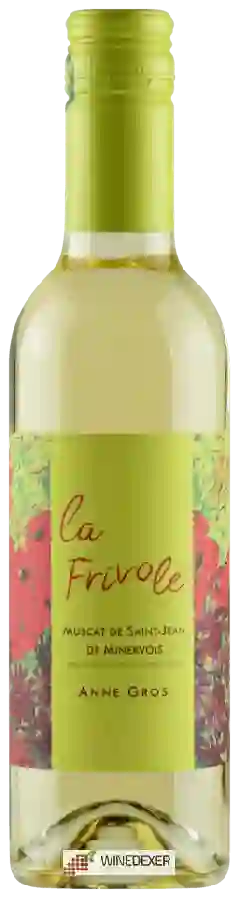
Domaine Anne GrosLa Frivole Muscat de Saint-Jean de Minervois
 Sweet wine


This wine generally goes well with spicy food and sweet desserts.
Food and wine pairings with La Frivole Muscat de Saint-Jean de Minervois
Pairings that work perfectly with La Frivole Muscat de Saint-Jean de Minervois


Original food and wine pairings with La Frivole Muscat de Saint-Jean de Minervois
The La Frivole Muscat de Saint-Jean de Minervois of Domaine Anne Gros matches generally quite well with dishes of spicy food or sweet desserts such as recipes of carrot soup with curry and coconut milk or pancakes.
Details and technical informations about Domaine Anne Gros's La Frivole Muscat de Saint-Jean de Minervois.
Discover the grape variety: Gouget noir
This grape variety was cultivated in the Montluçonnaise region (Allier) since the origin of the vineyards in this region. For a long time it was confused with Gougean de l'Allier, but genetic analyses show that it comes from a mutation of Gouais blanc, also called Gouget blanc. Gouget noir is practically on the verge of extinction, although it is listed in the Official Catalogue of Wine Grape Varieties, list A1. It was therefore very well known in the wine-growing centre of France but totally absent from other French regions and abroad.
Last vintages of this wine
The best vintages of La Frivole Muscat de Saint-Jean de Minervois from Domaine Anne Gros are 2017
Informations about the Domaine Anne Gros
The Domaine Anne Gros is one of of the world's great estates. It offers 26 wines for sale in the of Muscat de St. Jean de Minervois to come and discover on site or to buy online.

The wine region of Muscat de St. Jean de Minervois
Muscat de Saint-Jean-de-Minervois is a Sweet, fortified, natural wine appellation from the Languedoc wine region in Southern France. The wines are based on the Muscat Blanc a Petits Grains Grape variety. Muscat de Saint-Jean-de-Minervois wines are produced using a traditional sweet winemaking process called Mutage, which involves adding Alcohol to the grape must to prematurely stop the Yeast">yeast and thus the Fermentation process. They generally have a residual sugar content of about 125 grams per litre and an alcohol content of about 15%.
The wine region of Languedoc-Roussillon
Languedoc (formerly Coteaux du Languedoc) is a key appellation used in the Languedoc-Roussillon wine region of southern France. It covers Dry table wines of all three colors (red, white and rosé) from the entire region, but leaves Sweet and Sparkling wines to other more specialized appellations. About 75% of all Languedoc wines are red, with the remaining 25% split roughly down the middle between whites and rosés. The appellation covers most of the Languedoc region and almost a third of all the vineyards in France.
The word of the wine: Acerbe
Acidic taste with a certain astringency reminiscent of unripe fruit.