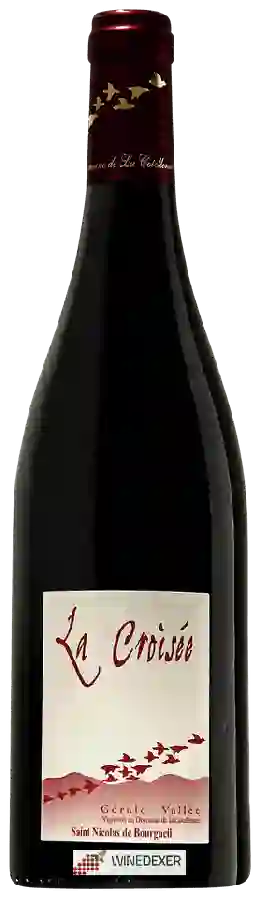
Domaine de la CotelleraieLa Croisée Saint-Nicolas-de-Bourgueil
 Red wine



In the mouth this red wine is a with a nice freshness.
This wine generally goes well with poultry, veal or game (deer, venison).

Taste structure of the La Croisée Saint-Nicolas-de-Bourgueil from the Domaine de la Cotelleraie
Light | Bold | |
Smooth | Tannic | |
Dry | Sweet | |
Soft | Acidic |
In the mouth the La Croisée Saint-Nicolas-de-Bourgueil of Domaine de la Cotelleraie in the region of Loire Valley is a with a nice freshness.
Wine flavors and olphactive analysis




On the nose the La Croisée Saint-Nicolas-de-Bourgueil of Domaine de la Cotelleraie in the region of Loire Valley often reveals types of flavors of smoke, black cherries or non oak and sometimes also flavors of earth, oak or spices.
Food and wine pairings with La Croisée Saint-Nicolas-de-Bourgueil
Pairings that work perfectly with La Croisée Saint-Nicolas-de-Bourgueil



Original food and wine pairings with La Croisée Saint-Nicolas-de-Bourgueil
The La Croisée Saint-Nicolas-de-Bourgueil of Domaine de la Cotelleraie matches generally quite well with dishes of veal, game (deer, venison) or poultry such as recipes of fillet of beef with morels, pizza of the south west : duck breast, roquefort or chicken blanquette.
Details and technical informations about Domaine de la Cotelleraie's La Croisée Saint-Nicolas-de-Bourgueil.
Discover the grape variety: Cabernet franc
Supple, fragrant reds with fine tannins and vibrant freshness, showing raspberry, violet, green pepper, pencil lead and gentle spice aromas. Star of the Loire as a single variety (Chinon, Bourgueil, Saumur-Champigny) and of the right bank of Bordeaux in blends (Cheval Blanc at 60%). Also in semi-dry Anjou rosés. A historic Bordeaux variety, parent of Cabernet-Sauvignon, Merlot and Carmenère.
Last vintages of this wine
The best vintages of La Croisée Saint-Nicolas-de-Bourgueil from Domaine de la Cotelleraie are 2016, 2014, 2018, 2015 and 2013.
Informations about the Domaine de la Cotelleraie
The Domaine de la Cotelleraie is one of of the world's greatest estates. It offers 22 wines for sale in the of Saint-Nicolas-de-Bourgueil to come and discover on site or to buy online.

The wine region of Saint-Nicolas-de-Bourgueil
Cabernet Franc (Breton) signature as monovarietal on the north bank of the Loire in Touraine, ≤10% Cabernet Sauvignon: fresh vibrant reds with bursting aromas of raspberry, cherry, blackcurrant and floral and spicy touches, fine tannins and silky palate. Light fruity gravel wines to drink young, more structured mineral tuffeau wines suitable for 5-6 years of aging. Luminous ruby robe. AOC neighbor of Bourgueil, pure Loire identity of Cabernet Franc.
The wine region of Loire Valley
Kingdom of lively, dry whites and fine sparklers. Mineral, taut Sauvignon Blanc (Sancerre, Pouilly-Fumé) with citrus and gunflint notes. Multiform Chenin Blanc (Vouvray, Savennières, Layon): straight dry, floral off-dry or noble sweet honey-quince. Saline, iodised Muscadet (Melon B.
The word of the wine: Assembly
Blending of several wines to obtain a single batch. Using wines of the same origin, blending is very different from coupage - a mixture of wines from different origins - which has a pejorative connotation.