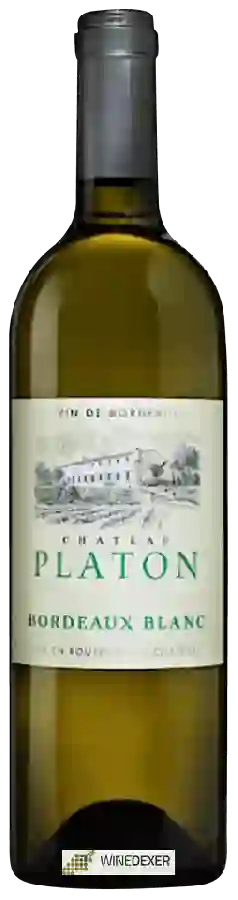
Château PlatonBordeaux Blanc
 White wine



In the mouth this white wine is a powerful.
This wine generally goes well with pork, vegetarian or poultry.
Taste structure of the Bordeaux Blanc from the Château Platon
Light | Bold | |
Dry | Sweet | |
Soft | Acidic |
In the mouth the Bordeaux Blanc of Château Platon in the region of Bordeaux is a powerful.
Food and wine pairings with Bordeaux Blanc
Pairings that work perfectly with Bordeaux Blanc



Original food and wine pairings with Bordeaux Blanc


The Bordeaux Blanc of Château Platon matches generally quite well with dishes of pork, vegetarian or poultry such as recipes of endive frichti, ham and comté quiche or moroccan kefta balls.
Details and technical informations about Château Platon's Bordeaux Blanc.
Discover the grape variety: Fantasy seedless
Cross between B36-27 and P64-18 obtained in the United States (California) by David Wilder Ramming and Ronald Tarailo and where it is cultivated since 1994. The slightly foxed taste of its flesh makes us think that there was an intervention of a direct producer hybrid itself with a foxed taste.
Last vintages of this wine
The best vintages of Bordeaux Blanc from Château Platon are 2016, 2017, 2015, 2014
Informations about the Château Platon
The Château Platon is one of of the world's greatest estates. It offers 3 wines for sale in the of Bordeaux to come and discover on site or to buy online.

The wine region of Bordeaux
Bordeaux, in southwestern France, is one of the most famous, prestigious and prolific wine regions in the world. The majority of Bordeaux wines (nearly 90% of the production Volume) are the Dry, medium and Full-bodied red Bordeaux blends for which it is famous. The finest (and most expensive) are the wines of the great châteaux of Haut-Médoc and the right bank appellations of Saint-Émilion and Pomerol. The former focuses (at the highest level) on Cabernet Sauvignon, the latter on Merlot.
The word of the wine: Petite arvine
An ancient white grape variety from the Valais (Switzerland), which produces renowned wines suitable for ageing. Viney and sustained by a strong vivacity, these wines express a fine salty touch, the signature of this variety. Petite arvine wines can be dry, tender or made from withered grapes from late harvesting. Syn.: arvine.