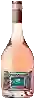
Château Saint AndréRosé
 Pink wine
This wine generally goes well with vegetarian, appetizers and snacks or lean fish.
Food and wine pairings with Rosé
Pairings that work perfectly with Rosé



Original food and wine pairings with Rosé


The Rosé of Château Saint André matches generally quite well with dishes of pasta, vegetarian or appetizers and snacks such as recipes of meat lasagna, quiche without eggs or aperitif puff pastries with vire andouille sausage.
Details and technical informations about Château Saint André's Rosé.
Discover the grape variety: Frankenthal
It is said to be of Austrian origin, from the Tyrol to be precise, and for some it comes from Franconia in Germany. Some ampelographers consider that Frankenthal and Kavcina crna or Zametovka grown in Slovenia are identical, with perhaps only a few clonal differences, which have yet to be confirmed, although it is true that they all have a large number of synonyms in common. Frankenthal can still be found in Belgium, the Netherlands, Germany, Austria, Hungary, Slovenia, Croatia, Italy, Portugal, England, Chile and Australia. For a long time, it was cultivated under greenhouses as a table grape in the North, East and West of France. Today, it has been almost abandoned and is therefore in danger of disappearing.
Informations about the Château Saint André
The Château Saint André is one of wineries to follow in Pays d'Oc.. It offers 24 wines for sale in the of Pays d'Oc to come and discover on site or to buy online.

The wine region of Pays d'Oc
Pays d'Oc is the PGI for red, white and rosé wines that are produced over a wide area of the southern coast of France. The PGI catchment area corresponds roughly to the Languedoc-roussillon">Languedoc-Roussillon wine region, one of the largest wine regions in France. The area covers all wines that are not produced under the strict laws that govern AOC-level appellations in the regions: among them, Corbières, Minervois and the Languedoc appellation itself. The Pays d'Oc PGI is arguably the most important in France, producing the majority of the country's PGI wines.
The word of the wine: VDQS
Delimited wine of superior quality. A level of appellation (today, barely 1% of French production) which constitutes the ultimate step before the accession to the AOC.