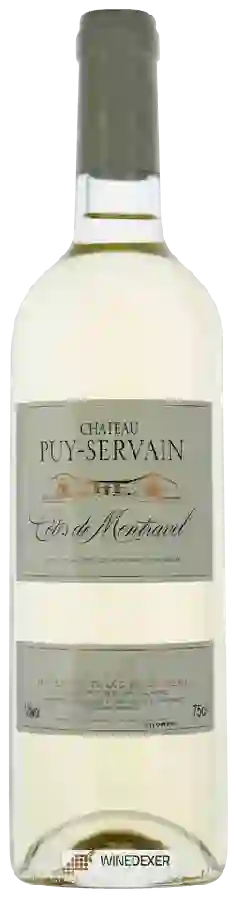
Château Puy-ServainCôtes de Montravel
 White wine
This wine generally goes well with poultry, rich fish (salmon, tuna etc) or shellfish.

Food and wine pairings with Côtes de Montravel
Pairings that work perfectly with Côtes de Montravel



Original food and wine pairings with Côtes de Montravel

The Côtes de Montravel of Château Puy-Servain matches generally quite well with dishes of rich fish (salmon, tuna etc), shellfish or sweet desserts such as recipes of tuna nuggets, tagliatelle with scallops or grandma's cherry clafoutis.
Details and technical informations about Château Puy-Servain's Côtes de Montravel.
Discover the grape variety: Pinot gris
Rich, ample whites with a golden robe, showing aromas of pear, quince, honey, smoke, ginger and spice. Made as structured dry wines (Alsace AOC), off-dry and sumptuous late-harvest sweet (vendange tardive, sélection de grains nobles). Lighter and crisper in Italy as Pinot Grigio (Veneto, Friuli). Also in Germany (Grauburgunder), Hungary (Szürkebarát) and Oregon. A grey mutation of Pinot Noir.
Informations about the Château Puy-Servain
The Château Puy-Servain is one of of the world's great estates. It offers 18 wines for sale in the of Côtes de Montravel to come and discover on site or to buy online.

The wine region of Côtes de Montravel
AOC for medium-sweet whites in Bergerac (Dordogne), on slopes extending those of Saint-Émilion and Castillon: predominantly Sémillon blended with Sauvignon and Muscadelle—lively, mineral and long on the palate. Pale gold, with ripe white fruits, citrus and honeyed notes, measured residual sugar balanced by freshness. Sandy-gravelly clay soils at rather acidic pH on terraces bordering the Dordogne, low fertility and good drainage. Temperate oceanic climate moderated by the river.
The wine region of South West
French mosaic of strong identities south of Bordeaux. Cahors and its Malbec ("black wine"): deep reds with notes of blackberry, plum, violet, tobacco and cocoa, firm tannins. Madiran and its dense, age-worthy Tannat. Jurançon whites: golden sweet (apricot, honey, pineapple) and lively dry from Petit Manseng.
The word of the wine: Maceration
Prolonged contact and exchange between the juice and the grape solids, especially the skin. Not to be confused with the time of fermentation, which follows maceration. The juice becomes loaded with colouring matter and tannins, and acquires aromas. For a rosé, the maceration is short so that the colour does not "rise" too much. For white wines too, a "pellicular maceration" can be practised, which allows the wine to acquire more fat.