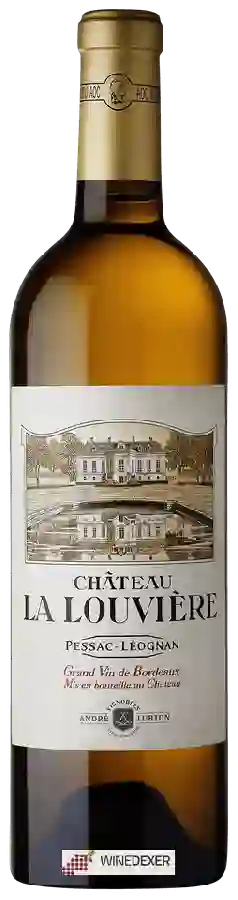
Château La LouvièrePessac-Léognan Blanc
 White wine


In the mouth this white wine is a powerful with a nice freshness.
This wine generally goes well with pork, vegetarian or poultry.
The Pessac-Léognan Blanc of the Château La Louvière is in the top 60 of wines of Pessac-Léognan.

Taste structure of the Pessac-Léognan Blanc from the Château La Louvière
Light | Bold | |
Dry | Sweet | |
Soft | Acidic |
In the mouth the Pessac-Léognan Blanc of Château La Louvière in the region of Bordeaux is a powerful with a nice freshness.
Wine flavors and olphactive analysis






On the nose the Pessac-Léognan Blanc of Château La Louvière in the region of Bordeaux often reveals types of flavors of pineapple, cream or grapefruit and sometimes also flavors of oaky, citrus or beeswax.
Food and wine pairings with Pessac-Léognan Blanc
Pairings that work perfectly with Pessac-Léognan Blanc



Original food and wine pairings with Pessac-Léognan Blanc


The Pessac-Léognan Blanc of Château La Louvière matches generally quite well with dishes of pork, vegetarian or poultry such as recipes of moist parmesan steak, zucchini quiche or fresh pasta.
Details and technical informations about Château La Louvière's Pessac-Léognan Blanc.
Discover the grape variety: Saint-Côme
Simple, lightly aromatic fresh whites with a pale golden robe, supple palate with moderate acidity, showing discrete citrus and white flower aromas. Discreet rustic South-West profile. Very rare, preserved for its heritage value, it survives in a few South-West heritage plots. White French autochtone variety from the South-West, considered identical to Bouysselet by some analyses.
Last vintages of this wine

The best vintages of Pessac-Léognan Blanc from Château La Louvière are 2012, 2009, 2007, 2016 and 2006.
Informations about the Château La Louvière
The Château La Louvière is one of of the world's greatest estates. It offers 10 wines for sale in the of Pessac-Léognan to come and discover on site or to buy online.

The wine region of Pessac-Léognan
Historic cradle of great Bordeaux wines south of the city: Cabernet Sauvignon signature king red with Merlot — deep robe with notes of blackcurrant, blackberry, cedar, tobacco, graphite, smoke and signature mineral 'stone taste' touch, fine tannins and long elegant finish. Sauvignon Blanc and Semillon in racy dry whites (citrus, flowers, honey, wax) among the world's greatest. AOC (1987), Quaternary gravels, 16 Classified Growths (Haut-Brion leading), 10-30 year ageing.
The wine region of Bordeaux
World-renowned age-worthy reds, led by round Merlot (plum, black fruit) or firm Cabernet Sauvignon (blackcurrant, cedar, graphite), blended with Cabernet Franc and Petit Verdot for tannic structure. Structured Médoc and Graves, velvety Saint-Émilion and Pomerol. Also crisp dry whites (Sauvignon/Sémillon) and opulent sweet Sauternes with honey and candied fruit. A 110,000 ha Gironde vineyard, 65 appellations, cradle of the 1855 classified growths.
The word of the wine: Trimming
A vineyard operation consisting of pruning the upper part of the branches after lifting, either manually or using a trimming machine attached to a high-clearance tractor.


