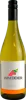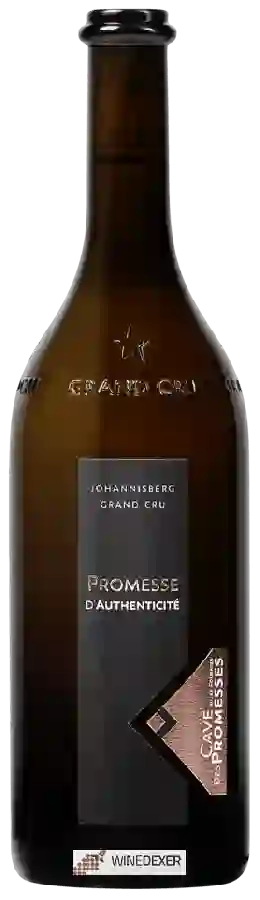
Cave des PromessesPromesse d'Authenticite Johannisberg Grand Cru
 White wine
This wine generally goes well with
The Promesse d'Authenticite Johannisberg Grand Cru of the Cave des Promesses is in the top 10 of wines of Valais.
Details and technical informations about Cave des Promesses's Promesse d'Authenticite Johannisberg Grand Cru.
Discover the grape variety: Picardan
Picardan is a white grape variety from Provence. Currently, this variety no longer exists. It is otherwise known as gallet blanc, grosse clairette, aragnan, papadoux or milhaud blanc. It is also called œillade blanche, but it has nothing to do with the œillade noire grape variety.Picardan has cottony buds and fairly large leaves. Its truncated cone-shaped bunches of grapes are tightly packed. The berries are smaller than those of Cinsault and are rather pinkish in colour when they reach maturity. Like Cinsault, Picardy is a late bloomer with a sweet, musky aroma. Vigorous, it is not too afraid of grey rot, but it is more sensitive to erinosis. Picardan is one of the grape varieties used in the Châteauneuf-du-Pape appellation. It gives a wine with a particular bouquet and when it is associated with other grape varieties such as mourvèdre or syrah. The rosé wine it produces is of good quality.
Informations about the Cave des Promesses
The Cave des Promesses is one of of the world's great estates. It offers 18 wines for sale in the of Valais to come and discover on site or to buy online.

The wine region of Valais
The Valais is the largest wine region and appellation in Switzerland, responsible for around one third of the country's total wine production. The main Vineyard area covers the southeast-facing slopes of the dramatic Rhône river valley as the glacial waters run southwest between Leuk (Loeche in French) and Fully. The river changes direction at Martigny and then runs northwest to exit the valley and empty into Lac Léman (Lake Geneva). Vineyard area here comes to around 4,800 hectares (11,800 acres) and is generally located on (often steep) slopes and terraces between the flat, fertile, Heavy soils at the bottom of the valley - often given over to fruit production, industry and urban development - and the bare rock of the mountainside that towers above.
The word of the wine: Mouth
The mouth is the third stage of wine tasting after the eye and nose. In the mouth, the taster identifies the aromas through the retronasal route, the flavours and the texture. It is in the mouth that the overall balance of the wine is apprehended.