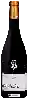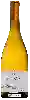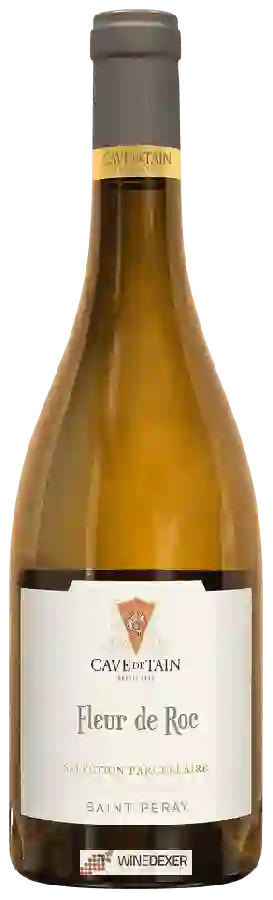
Cave de TainFleur de Roc Saint Péray
 White wine



This wine is a blend of 2 varietals which are the Marsanne and the Roussanne.
In the mouth this white wine is a with a nice freshness.
This wine generally goes well with vegetarian, rich fish (salmon, tuna etc) or shellfish.

Taste structure of the Fleur de Roc Saint Péray from the Cave de Tain
Light | Bold | |
Dry | Sweet | |
Soft | Acidic |
In the mouth the Fleur de Roc Saint Péray of Cave de Tain in the region of Rhone Valley is a with a nice freshness.
Wine flavors and olphactive analysis






On the nose the Fleur de Roc Saint Péray of Cave de Tain in the region of Rhone Valley often reveals types of flavors of peach, minerality or vanilla and sometimes also flavors of pear, honey or non oak.
Food and wine pairings with Fleur de Roc Saint Péray
Pairings that work perfectly with Fleur de Roc Saint Péray



Original food and wine pairings with Fleur de Roc Saint Péray

The Fleur de Roc Saint Péray of Cave de Tain matches generally quite well with dishes of rich fish (salmon, tuna etc), shellfish or vegetarian such as recipes of niçoise salad, raoul's bouillabaisse or leek, goat cheese and bacon quiche.
Details and technical informations about Cave de Tain's Fleur de Roc Saint Péray.
Discover the grape variety: Marsanne
Rich, structured whites with a round palate and long finish, with aromas of ripe yellow fruits, honey, white flowers, toasted almond and mineral notes. Fine ageing potential, developing waxy and truffle nuances with age. Key variety in the great whites of the northern Rhône (Hermitage, Crozes-Hermitage, Saint-Joseph, Saint-Péray) blended with roussanne. Also exported to Australia (Victoria) and California. Native Rhône variety.
Last vintages of this wine
The best vintages of Fleur de Roc Saint Péray from Cave de Tain are 2015, 2017, 2016, 2010 and 2014.
Informations about the Cave de Tain
The Cave de Tain is one of of the world's great estates. It offers 219 wines for sale in the of Saint-Péray to come and discover on site or to buy online.

The wine region of Saint-Péray
Cru of the northern Rhone (right bank, west of Valence, Ardeche, granitic soils): signature dominant Marsanne as white king (90%) with Roussanne — sparkling style (2/3 of production) with pale straw robe, floral nose, aromas of chestnut, apricot, toast, honey and almond, fine bubbles and airy mousse. Still wines with low acidity: dried apricot, acacia, beeswax, quince, white peach. Champagne method since 1829, signature finesse.
The wine region of Rhone Valley
France's 2nd-largest AOC vineyard, two complementary worlds. Northern: pure Syrah in signature reds (Côte-Rôtie, Hermitage, Cornas), deep and peppery with blackberry, violet, black olive and smoked bacon notes, exceptional ageing. Opulent Viognier whites (Condrieu, apricot, flowers) and ample Marsanne-Roussanne. Southern: sun-soaked Grenache blends at Châteauneuf, Gigondas, Vacqueyras (candied fruit, garrigue).
The word of the wine: Ugni blanc
White grape variety of Italian origin, and the main white variety grown in France. Its large bunches give fine, light and lively wines, suitable for distillation: today it is the main variety for making cognac and armagnac. Ugni blanc, which is a little richer in alcohol when grown in Mediterranean regions, is used in the blending of the Provence and Corsica appellations, often in association with other grape varieties that bring aromas and structure, such as clairette, grenache blanc or sauvignon. Ugni blanc is also used, on a secondary basis, in the production of certain white wines in Gironde (AOC Bordeaux, Entre-deux-Mers, etc.).