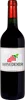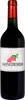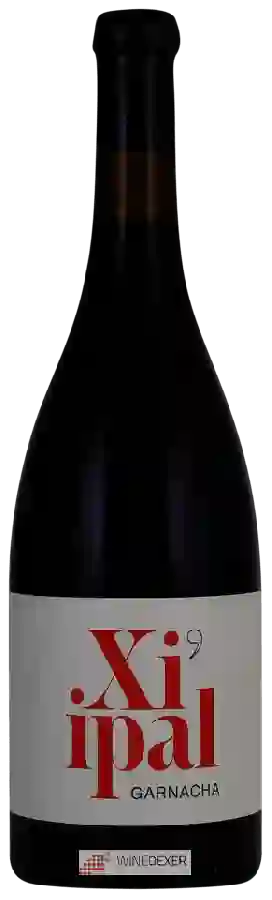
Winery CaudaliaXi'Ipal Garnacha
 Red wine


In the mouth this red wine is a powerful with a lot of tannins present in the mouth.
This wine generally goes well with poultry, beef or game (deer, venison).
Taste structure of the Xi'Ipal Garnacha from the Winery Caudalia
Light | Bold | |
Smooth | Tannic | |
Dry | Sweet | |
Soft | Acidic |
In the mouth the Xi'Ipal Garnacha of Winery Caudalia in the region of Navarre is a powerful with a lot of tannins present in the mouth.


Food and wine pairings with Xi'Ipal Garnacha
Pairings that work perfectly with Xi'Ipal Garnacha



Original food and wine pairings with Xi'Ipal Garnacha


The Xi'Ipal Garnacha of Winery Caudalia matches generally quite well with dishes of beef, pasta or lamb such as recipes of alsatian bäckeoffe, rigatoni with courgettes and tomatoes or lamb mice confit and melting carrots.
Details and technical informations about Winery Caudalia's Xi'Ipal Garnacha.
Discover the grape variety: Ribier noir
Most certainly originating from the department of Ardeche, more precisely from the region between Aubenas, Privas, Saint Péray, ... . It could also be found in the Galaure valley in the Drôme department as well as in Isère. It is said to be the mother of the raisin, another Ardèche grape variety. Today, Ribier is no longer planted, which means it is almost certain to disappear. It should not be confused with Alphonse Lavallée, which is synonymous with ribier, with marocain or ribier du Maroc, ... .
Last vintages of this wine
The best vintages of Xi'Ipal Garnacha from Winery Caudalia are 2015, 0
Informations about the Winery Caudalia
The Winery Caudalia is one of of the world's greatest estates. It offers 11 wines for sale in the of Navarre to come and discover on site or to buy online.

The wine region of Navarre
Navarra, in northern Spain, is one of the country's 17 first-level administrative regions (comunidades autónomas) and a fairly prolific, if lesser-known, wine region. Traditionally associated with the production of Bright, Fruity rosé, Navarra is beginning to attract attention for its high-quality red wines, mainly from the Tempranillo, Cabernet Sauvignon and Merlot grapes, after years of being overshadowed by its southern neighbor, Rioja. The first evidence of wine-making in the region dates back to Roman times, but it is almost certain that Vines were growing here Long before that. It was recently discovered that vines of the prehistoric species Vitis sylvestris - the predecessor of the beloved Vitis vinifera - were still growing in Navarre.
The word of the wine: Ugni blanc
White grape variety of Italian origin, and the main white variety grown in France. Its large bunches give fine, light and lively wines, suitable for distillation: today it is the main variety for making cognac and armagnac. Ugni blanc, which is a little richer in alcohol when grown in Mediterranean regions, is used in the blending of the Provence and Corsica appellations, often in association with other grape varieties that bring aromas and structure, such as clairette, grenache blanc or sauvignon. Ugni blanc is also used, on a secondary basis, in the production of certain white wines in Gironde (AOC Bordeaux, Entre-deux-Mers, etc.).