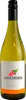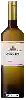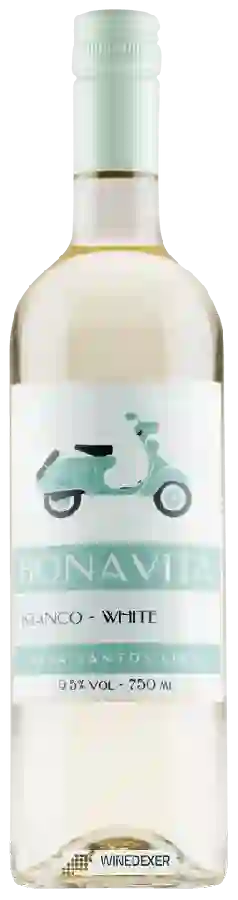
Winery Casa Santos LimaBonavita Branco
 White wine



In the mouth this white wine is a .
This wine generally goes well with pork, lean fish or shellfish.

Taste structure of the Bonavita Branco from the Winery Casa Santos Lima
Light | Bold | |
Dry | Sweet | |
Soft | Acidic |
In the mouth the Bonavita Branco of Winery Casa Santos Lima in the region of Lisboa is a .
Food and wine pairings with Bonavita Branco
Pairings that work perfectly with Bonavita Branco



Original food and wine pairings with Bonavita Branco

The Bonavita Branco of Winery Casa Santos Lima matches generally quite well with dishes of pasta, pork or shellfish such as recipes of lasagna with courgettes and fresh goat cheese, ham croquette with purée or fideuà (paella with pasta and fish).
Details and technical informations about Winery Casa Santos Lima's Bonavita Branco.
Discover the grape variety: Fernao Pires
Aromatic and lively whites with a tender palate and fresh acidity, on intense aromas of white flowers (orange blossom, acacia), citrus, white peach, muscat and spiced notes. Made as dry whites, popular off-dry styles and in sparkling wines from Bairrada. Also called Maria Gomes in Bairrada DOC. Widely grown in Ribatejo, Tejo DOC and Lisboa, one of Portugal's most planted white grapes. Native Portuguese variety.
Last vintages of this wine
The best vintages of Bonavita Branco from Winery Casa Santos Lima are 2016, 2014, 2017, 2015 and 2018.
Informations about the Winery Casa Santos Lima
The Winery Casa Santos Lima is one of of the world's greatest estates. It offers 104 wines for sale in the of Lisboa to come and discover on site or to buy online.

The wine region of Lisboa
Vast coastal IGP north of Lisbon, Portugal's largest producer by volume. Accessible, sun-filled reds: fruity, spicy Castelão, dense Touriga Nacional (black fruit, violet), fleshy Trincadeira, deep Alicante Bouschet. Fresh, mineral whites: straight, lemony Arinto (star of Bucelas), aromatic Fernão Pires, round Vital and Malvasia. Structured reds from Alenquer, sparkling at Óbidos.
The word of the wine: Reassembly
During the vinification process, a "cap" is formed at the top of the vats with the solid parts (skin, pulp, pips, etc.), which contain tannins and colouring elements. Pumping over consists of emptying the vat from the bottom and pouring the juice back to the top, in order to mix the cap and the juice and to favour the exchange and the extraction. This old technique allows a better exchange between the solid parts and the liquid.