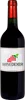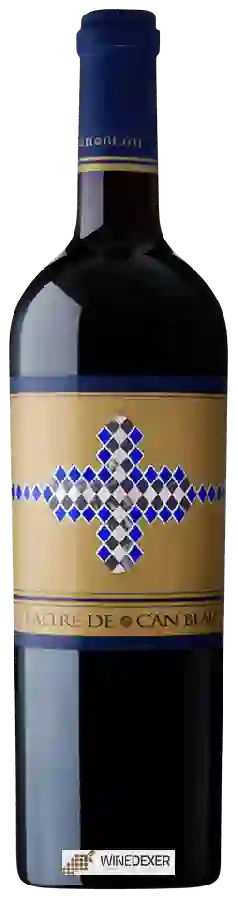
Winery Can BlauL'Altre de Can Blau
 Red wine



In the mouth this red wine is a powerful with a nice balance between acidity and tannins.
This wine generally goes well with beef, lamb or pasta.
The L'Altre de Can Blau of the Winery Can Blau is in the top 90 of wines of Montsant.

Taste structure of the L'Altre de Can Blau from the Winery Can Blau
Light | Bold | |
Smooth | Tannic | |
Dry | Sweet | |
Soft | Acidic |
In the mouth the L'Altre de Can Blau of Winery Can Blau in the region of Catalogne is a powerful with a nice balance between acidity and tannins.
Wine flavors and olphactive analysis


On the nose the L'Altre de Can Blau of Winery Can Blau in the region of Catalogne often reveals types of flavors of oak, red fruit or black fruit and sometimes also flavors of dried fruit.
Food and wine pairings with L'Altre de Can Blau
Pairings that work perfectly with L'Altre de Can Blau



Original food and wine pairings with L'Altre de Can Blau
The L'Altre de Can Blau of Winery Can Blau matches generally quite well with dishes of beef, pasta or lamb such as recipes of pastasciutta (corsica), fish lasagne or shoulder of lamb stuffed with cognac.
Details and technical informations about Winery Can Blau's L'Altre de Can Blau.
Discover the grape variety: Seibel 6468
Simple, lively whites with a pale golden robe, an airy palate with preserved acidity, and undemonstrative aromas of citrus and white flowers. Productive and disease-resistant. Now marginal, surviving in a few heritage plots in France, it belongs to the old hybrids preserved in variety collections for their genetic and historical interest. A French white hybrid grape bred by Albert Seibel in the early 20th century.
Last vintages of this wine
The best vintages of L'Altre de Can Blau from Winery Can Blau are 2015, 2012, 2014, 0 and 2013.
Informations about the Winery Can Blau
The Winery Can Blau is one of of the world's greatest estates. It offers 11 wines for sale in the of Montsant to come and discover on site or to buy online.

The wine region of Montsant
Catalan ring encircling the Priorat (Tarragona): signature Garnacha and Cariñena as king reds — concentrated and sunny with notes of ripe black fruits (blackberry, blackcurrant, plum), garrigue, Mediterranean herbs, liquorice and a mineral touch, fleshy tannins and a moreish finish, more accessible and fruity than Priorat. Syrah and Cabernet as backup. A few whites (Garnacha Blanca, Macabeu). DO (2001), schists ("llicorella") and clay-limestones, Mediterranean-continental climate.
The wine region of Catalogne
Cradle of Cava (~95% of Spanish output, traditional method): Macabeo, Xarel-lo, Parellada trilogy, fine fruity bubble. Quality peak in Priorat DOCa: dense, mineral reds on llicorella (schist), old-vine Garnacha and Cariñena with black fruit, garrigue notes, firm tannins. Also Penedès, fleshy Montsant, sunny Empordà, Costers del Segre. Mediterranean.
The word of the wine: Residual sugars
Sugars not transformed into alcohol and naturally present in the wine. The perception of residual sugars is conditioned by the acidity of the wine. The more acidic the wine is, the less sweet it will seem, given the same amount of sugar.