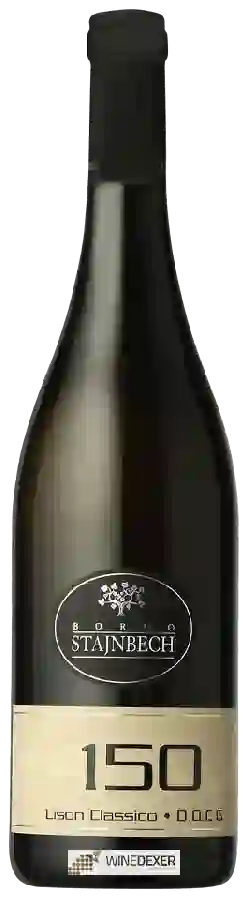
Winery Borgo Stajnbech150 Lison Classico
 White wine



In the mouth this white wine is a powerful with a nice freshness.
This wine generally goes well with lean fish, shellfish or mature and hard cheese.
Taste structure of the 150 Lison Classico from the Winery Borgo Stajnbech
Light | Bold | |
Dry | Sweet | |
Soft | Acidic |
In the mouth the 150 Lison Classico of Winery Borgo Stajnbech in the region of Veneto is a powerful with a nice freshness.
Food and wine pairings with 150 Lison Classico
Pairings that work perfectly with 150 Lison Classico



Original food and wine pairings with 150 Lison Classico


The 150 Lison Classico of Winery Borgo Stajnbech matches generally quite well with dishes of pasta, shellfish or mature and hard cheese such as recipes of fideuà (paella with pasta and fish), scallops or smoked salmon and comté pie.
Details and technical informations about Winery Borgo Stajnbech's 150 Lison Classico.
Discover the grape variety: Cabernet-Cantor
Interspecific crossing between Chancellor and Solaris made in 1989 by Norbert Becker of the Freiburg Research Institute in Germany. Cabernet-Cantor can be found in Germany, Switzerland, the Netherlands, Belgium, Lithuania, Poland, ... little known in France.
Last vintages of this wine
The best vintages of 150 Lison Classico from Winery Borgo Stajnbech are 1988, 2017, 2015, 2013 and 2012.
Informations about the Winery Borgo Stajnbech
The Winery Borgo Stajnbech is one of of the world's greatest estates. It offers 22 wines for sale in the of Lison Classico to come and discover on site or to buy online.

The wine region of Lison Classico
The wine region of Lison Classico is located in the region of Lison of Vénétie of Italy. Wineries and vineyards like the Domaine Borgo Stajnbech or the Domaine Tenuta Sant’Anna (S. Anna) produce mainly wines white. The most planted grape varieties in the region of Lison Classico are Chardonnay, they are then used in wines in blends or as a single variety.
The wine region of Veneto
Veneto is an important and growing wine region in northeastern Italy. Veneto is administratively Part of the Triveneto area, aLong with its smaller neighbors, Trentino-Alto Adige and Friuli-Venezia Giulia. In terms of geography, culture and wine styles, it represents a transition from the Alpine and Germanic-Slavic end of Italy to the warmer, drier, more Roman lands to the South. Veneto is slightly smaller than the other major Italian wine regions - Piedmont, Tuscany, Lombardy, Puglia and Sicily - but it produces more wine than any of them.
The word of the wine: Liquid
Sweet wine containing more than 50 grams of residual sugar per liter. Sweet wines are made from grapes often affected by botrytis cinerea and concentrated either by passerillage (drying of the grapes on the vine stock), or after the harvest (straw wines), or by the cold (ice wines).