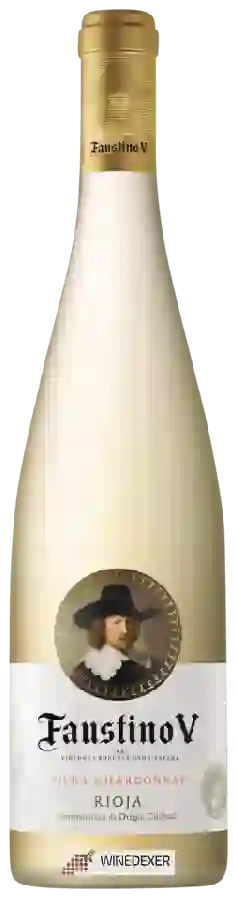
Bodegas FaustinoV Bianco
 White wine


In the mouth this white wine is a powerful with a nice freshness.
This wine generally goes well with appetizers and snacks, lean fish or shellfish.

Taste structure of the V Bianco from the Bodegas Faustino
Light | Bold | |
Dry | Sweet | |
Soft | Acidic |
In the mouth the V Bianco of Bodegas Faustino in the region of Rioja is a powerful with a nice freshness.
Wine flavors and olphactive analysis






On the nose the V Bianco of Bodegas Faustino in the region of Rioja often reveals types of flavors of non oak, earth or microbio and sometimes also flavors of vegetal, oak or tree fruit.
Food and wine pairings with V Bianco
Pairings that work perfectly with V Bianco



Original food and wine pairings with V Bianco

The V Bianco of Bodegas Faustino matches generally quite well with dishes of shellfish, appetizers and snacks or lean fish such as recipes of salt and pepper shrimp, hummus (chickpea puree) or back of cod in foil.
Details and technical informations about Bodegas Faustino's V Bianco.
Discover the grape variety: Picolit noir
Light, fruity reds with a clear ruby colour, silky tannins and an airy palate, with aromas of red fruits (cherry, raspberry) and delicate floral notes. Discreet Friulian profile. Very rare, preserved for its heritage value, this dark-skinned mutation of the white Picolit survives in a few heritage plots in Friuli. An ancient north-east Italian variety.
Last vintages of this wine

The best vintages of V Bianco from Bodegas Faustino are 2001, 2018, 2011, 2010 and 2017.
Informations about the Bodegas Faustino
The Bodegas Faustino is one of of the world's great estates. It offers 57 wines for sale in the of Rioja to come and discover on site or to buy online.

The wine region of Rioja
Star of great Spanish reds: signature Tempranillo, elegant and complex, with notes of ripe cherry, plum, leather, vanilla and tobacco from American oak ageing. Classification by age: fruity Joven, balanced Crianza, ample Reserva, deep, silky Gran Reserva (5 years, 2 in barrel). Some fresh Viura whites and generous rosés. Spain's first DOCa (1991), 3 sub-zones (Alta, Alavesa, Oriental), 93.
The word of the wine: Second fermentation
In the making of champagne, fermentation of the base wine to which is added the liqueur de tirage and which takes place in the bottle. This second fermentation produces the carbon dioxide, and therefore the bubbles that make up the effervescence of the wine.


