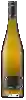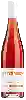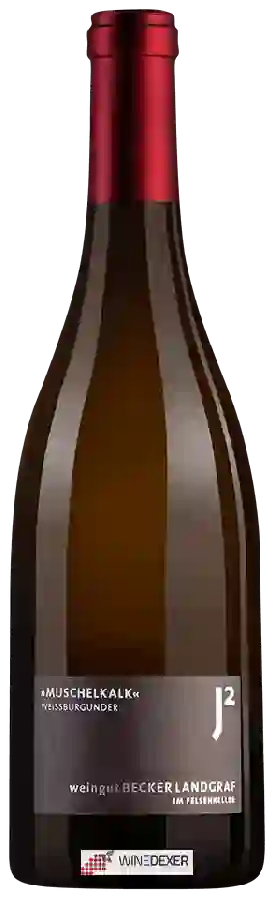
Winery Becker LandgrafJ² Muschelkalk Weissburgunder
 White wine


In the mouth this white wine is a powerful with a nice freshness.
This wine generally goes well with rich fish (salmon, tuna etc), shellfish or mild and soft cheese.

Taste structure of the J² Muschelkalk Weissburgunder from the Winery Becker Landgraf
Light | Bold | |
Dry | Sweet | |
Soft | Acidic |
In the mouth the J² Muschelkalk Weissburgunder of Winery Becker Landgraf in the region of Rheinhessen is a powerful with a nice freshness.
Wine flavors and olphactive analysis




On the nose the J² Muschelkalk Weissburgunder of Winery Becker Landgraf in the region of Rheinhessen often reveals types of flavors of microbio, oak.
Food and wine pairings with J² Muschelkalk Weissburgunder
Pairings that work perfectly with J² Muschelkalk Weissburgunder


Original food and wine pairings with J² Muschelkalk Weissburgunder

The J² Muschelkalk Weissburgunder of Winery Becker Landgraf matches generally quite well with dishes of rich fish (salmon, tuna etc), shellfish or mild and soft cheese such as recipes of salmon and parmesan quiche without pastry, salt and pepper shrimp or reblochon tartiflette.
Details and technical informations about Winery Becker Landgraf's J² Muschelkalk Weissburgunder.
Discover the grape variety: Pascal Blanc
Supple, low-acid whites with a pale golden robe and an ample palate, with discreet signature aromas of white fruit (apple, pear) and light floral notes. Confidential heritage profile. Almost extinct, preserved in the Domaine de Vassal collections (INRAE), bearing witness to the ampelographic richness of pre-phylloxera Provence. Autochthonous Provençal white variety, once grown in the Var and Bouches-du-Rhône.
Last vintages of this wine

The best vintages of J² Muschelkalk Weissburgunder from Winery Becker Landgraf are 2018, 2009, 0, 2015
Informations about the Winery Becker Landgraf
The Winery Becker Landgraf is one of of the world's great estates. It offers 37 wines for sale in the of Rheinhessen to come and discover on site or to buy online.

The wine region of Rheinhessen
71% white region: Riesling is king (5,000 ha), dry to off-dry, ripe yellow fruit, apple, citrus and fine saline minerality. Supple, floral Müller-Thurgau for everyday, the world's largest Silvaner plantation with herbaceous, straight notes. Historic cradle of off-sweet Liebfraumilch. Some supple reds (Dornfelder, Spätburgunder).
The word of the wine: Chambered
Said of a wine served at a temperature around 18 °.