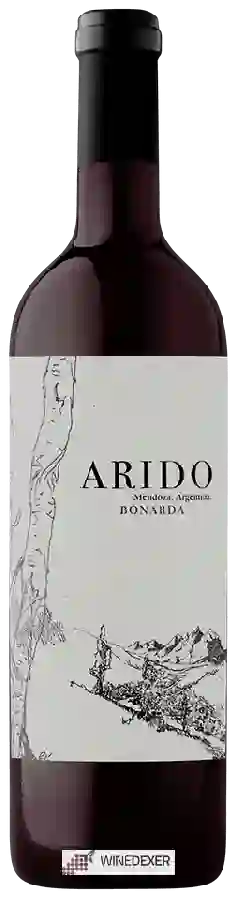
Winery ÁridoBonarda
 Red wine



In the mouth this red wine is a powerful with a nice freshness.
This wine generally goes well with pork, poultry or veal.
Taste structure of the Bonarda from the Winery Árido
Light | Bold | |
Smooth | Tannic | |
Dry | Sweet | |
Soft | Acidic |
In the mouth the Bonarda of Winery Árido in the region of Mendoza is a powerful with a nice freshness.
Wine flavors and olphactive analysis



On the nose the Bonarda of Winery Árido in the region of Mendoza often reveals types of flavors of non oak, oak or spices and sometimes also flavors of red fruit, black fruit.
Food and wine pairings with Bonarda
Pairings that work perfectly with Bonarda



Original food and wine pairings with Bonarda

The Bonarda of Winery Árido matches generally quite well with dishes of veal, pork or game (deer, venison) such as recipes of roast veal with chanterelles and cream, gloom and doom or rabbit with hunter's sauce.
Details and technical informations about Winery Árido's Bonarda.
Discover the grape variety: Kadarka
Some say that it originated in Hungary, while others say it came from Turkey via Bulgaria. Known in Austria and more generally in Eastern Europe (Albania, Croatia, Moldavia, Slovakia, Romania, Serbia, etc.), it is registered in the Official Catalogue of Wine Grape Varieties, list A1.
Last vintages of this wine
The best vintages of Bonarda from Winery Árido are 2015, 2016, 2017, 0
Informations about the Winery Árido
The Winery Árido is one of of the world's greatest estates. It offers 7 wines for sale in the of Mendoza to come and discover on site or to buy online.

The wine region of Mendoza
Mendoza is by far the largest wine region in Argentina. Located on a high-altitude plateau at the edge of the Andes Mountains, the province is responsible for roughly 70 percent of the country's annual wine production. The French Grape variety Malbec has its New World home in the vineyards of Mendoza, producing red wines of great concentration and intensity. The province Lies on the western edge of Argentina, across the Andes Mountains from Chile.
The word of the wine: Density per hectare
Number of vines per hectare. For the same yield, a vine planted with 3,000 vines per hectare bears many more bunches (per vine) than a vine planted with 10,000. The grapes will therefore be less rich in sugar and polyphenols (tannins, aromas...).