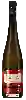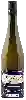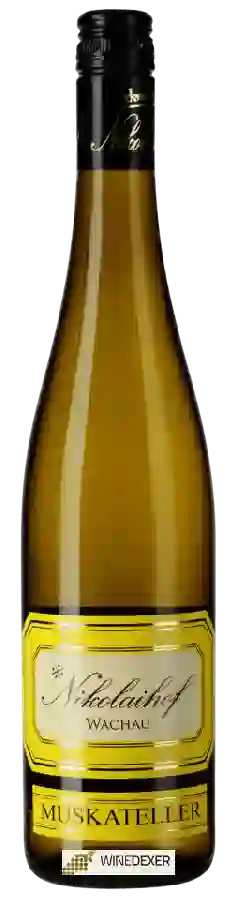
Winery NikolaihofMuskateller
 White wine



This wine generally goes well with
Wine flavors and olphactive analysis



On the nose the Muskateller of Winery Nikolaihof in the region of Weinland often reveals types of flavors of oak, tree fruit or citrus fruit and sometimes also flavors of tropical fruit.
Details and technical informations about Winery Nikolaihof's Muskateller.
Discover the grape variety: Carricante
It is most certainly of Italian origin, more precisely from Sicily where it is very present, especially on the slopes of the eastern and southern slopes of Mount Etna. It is thought to be the result of a natural cross between montonico pinto and scacco. It has often been confused with the catarratto even today. Carricante is identified today by two known biotypes, A and B, ... a variety almost unknown in France, but registered in the Official Catalogue of wine grape varieties, list A1.
Last vintages of this wine
The best vintages of Muskateller from Winery Nikolaihof are 2013, 2007, 0, 2016
Informations about the Winery Nikolaihof
The Winery Nikolaihof is one of of the world's great estates. It offers 48 wines for sale in the of Wachau to come and discover on site or to buy online.

The wine region of Wachau
The wine region of Wachau is located in the region of Niederösterreich of Weinland of Austria. We currently count 156 estates and châteaux in the of Wachau, producing 1238 different wines in conventional, organic and biodynamic agriculture. The wines of Wachau go well with generally quite well with dishes .
The wine region of Weinland
Weinviertel DAC – whose name translates as "wine quarter" – is an appellation in Niederösterreich (Lower Austria). It is by far the largest Districtus Austriae Controllatus wine region in Austria. It was also the first Austrian wine region to be given that title, in 2002, with a DAC Reserve designation added in 2009. The designation applies only to white wines from the Grüner Veltliner Grape variety.
The word of the wine: Cinsault
Cinsault is a southern black grape variety that can be found in the blends of most Mediterranean appellations, but most often as an accessory grape variety. It is undoubtedly most present in certain rosé wines (in Corbières, Côtes-de-Provence, etc.): it gives these wines highly appreciated aromas of strawberry, peach and raspberry. In vin de pays (IGP), it is often vinified on its own, usually as a rosé.