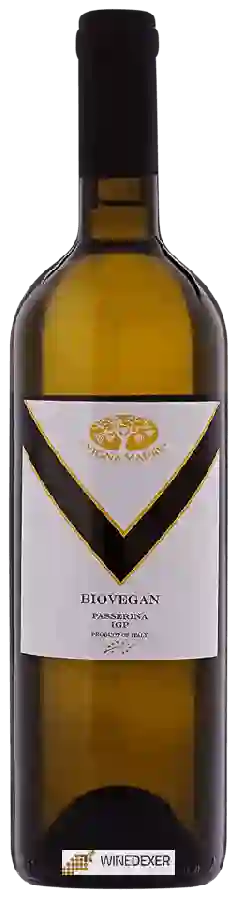
Winery Vigna MadreBiovegan Passerina
 White wine


In the mouth this white wine is a powerful.
This wine generally goes well with vegetarian, appetizers and snacks or shellfish.
Taste structure of the Biovegan Passerina from the Winery Vigna Madre
Light | Bold | |
Dry | Sweet | |
Soft | Acidic |
In the mouth the Biovegan Passerina of Winery Vigna Madre in the region of Abruzzo is a powerful.
Food and wine pairings with Biovegan Passerina
Pairings that work perfectly with Biovegan Passerina



Original food and wine pairings with Biovegan Passerina
The Biovegan Passerina of Winery Vigna Madre matches generally quite well with dishes of shellfish, vegetarian or appetizers and snacks such as recipes of aïoli, quiche without pastry, courgette and blue cheese or patatas bravas (fried potatoes with spicy tomato sauce).
Details and technical informations about Winery Vigna Madre's Biovegan Passerina.
Discover the grape variety: Flame seedless
Apyrene variety of table grapes obtained in 1961 in the United States (California) by John H. Weinberger and F.N. Harmon by complex crossing between (cardinal x sultanin) x [(molinera gorda x tifafihi ahmer ) x (muscat of Alexandria x sultanin)] and put in culture in 1973. It should be noted that the white Fresno seedless is the result of the same cross made by the same breeders. It can be found in Australia, Chile, Argentina, South Africa, Morocco, Tunisia, Spain, Portugal, Italy, Bulgaria, the United States (California) where it occupies a large area, etc. In France it is practically unknown, although it is registered in the Official Catalogue of table grape varieties, list A2.
Last vintages of this wine
The best vintages of Biovegan Passerina from Winery Vigna Madre are 0
Informations about the Winery Vigna Madre
The Winery Vigna Madre is one of of the world's great estates. It offers 35 wines for sale in the of Abruzzo to come and discover on site or to buy online.

The wine region of Abruzzo
Abruzzo is an Italian wine region located on the eastern (Adriatic) coast. Its immediate neighbors in CentralItaly are Marche to the North, Lazio to the west and southwest and Molise to the southeast. Abruzzo has one DOCG - Montepulciano d'Abruzzo Colline Teramane - and three DOC wine appellations. The reds and Cerasuolo d'Abruzzo and Montepulciano d'Abruzzo, as well as the white wine appellation Trebbiano d'Abruzzo are the most notable, followed by the lesser-known Controguerra.
The word of the wine: Table wine
Everything that is not VQPRD (European designation for all appellation wines: quality wine produced in a specific region). In principle, the bottom of the ladder. But, as in Italy a decade ago (Vino da Tavola), this category is also a refuge for wines that are out of the ordinary, whose producers refuse to accept certain grape variety or vinification dictates.