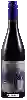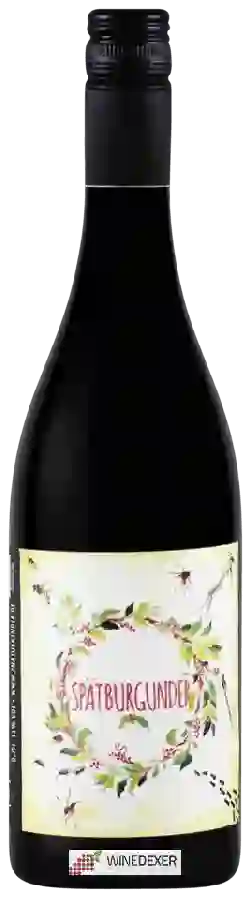
Winery 2NaturkinderSpätburgunder
 Red wine



In the mouth this red wine is a with a nice freshness.
This wine generally goes well with poultry, beef or veal.
Taste structure of the Spätburgunder from the Winery 2Naturkinder
Light | Bold | |
Smooth | Tannic | |
Dry | Sweet | |
Soft | Acidic |
In the mouth the Spätburgunder of Winery 2Naturkinder in the region of Franken is a with a nice freshness.
Wine flavors and olphactive analysis


On the nose the Spätburgunder of Winery 2Naturkinder in the region of Franken often reveals types of flavors of spices, red fruit.
Food and wine pairings with Spätburgunder
Pairings that work perfectly with Spätburgunder



Original food and wine pairings with Spätburgunder

The Spätburgunder of Winery 2Naturkinder matches generally quite well with dishes of beef, veal or game (deer, venison) such as recipes of fillet of beef in a foie gras and truffle crust, veal paupiettes à la bourguignonne or garbure with duck confit.
Details and technical informations about Winery 2Naturkinder's Spätburgunder.
Discover the grape variety: Ravat blanc
Interspecific crossing between Seibel 5474 (Seibel 405 x Seibel 867) and Chardonnay by Jean-François Ravat. After 1945, it was already considered a quality grape variety, and is now listed in the Official Catalogue of Vine Varieties, list A1.
Last vintages of this wine
The best vintages of Spätburgunder from Winery 2Naturkinder are 2017, 0, 2016, 2015
Informations about the Winery 2Naturkinder
The Winery 2Naturkinder is one of of the world's great estates. It offers 20 wines for sale in the of Franken to come and discover on site or to buy online.

The wine region of Franken
Franken, or Franconia in English, is a wine-growing region in the northwest of Germany's historic state of Bavaria. Though Bavaria may be more famous for its beer, Franken boasts a proud viticultural tradition and is one of the most unique regions in the country. There are just over 6,100 hectares (15,073 ac) of vines Planted in Franken and around 80 percent of these are white Grape varieties. Here, Riesling plays second fiddle to the often overlooked Silvaner and Müller-Thurgau.
The word of the wine: Oenologist
Specialist in wine-making techniques. It is a profession and not a passion: one can be an oenophile without being an oenologist (and the opposite too!). Formerly attached to the Faculty of Pharmacy, oenology studies have become independent and have their own university course. Learning to make wine requires a good chemical background but also, increasingly, a good knowledge of the plant. Some oenologists work in laboratories (analysis). Others, the consulting oenologists, work directly in the properties.