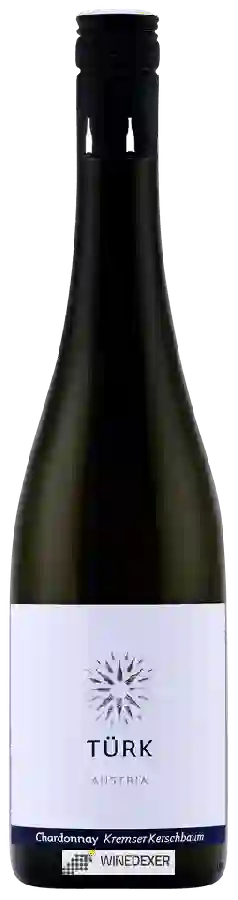
Winery TürkChardonnay Kremser Kerschbaum
 White wine



This wine is composed of 100% of the grape variety Chardonnay.
In the mouth this white wine is a with a nice freshness.
This wine generally goes well with pork, vegetarian or poultry.

Taste structure of the Chardonnay Kremser Kerschbaum from the Winery Türk
Light | Bold | |
Dry | Sweet | |
Soft | Acidic |
In the mouth the Chardonnay Kremser Kerschbaum of Winery Türk in the region of Weinland is a with a nice freshness.
Food and wine pairings with Chardonnay Kremser Kerschbaum
Pairings that work perfectly with Chardonnay Kremser Kerschbaum



Original food and wine pairings with Chardonnay Kremser Kerschbaum

The Chardonnay Kremser Kerschbaum of Winery Türk matches generally quite well with dishes of pork, rich fish (salmon, tuna etc) or vegetarian such as recipes of homemade pork curry, baked cod portuguese style or light tuna-tomato quiche (without cream).
Details and technical informations about Winery Türk's Chardonnay Kremser Kerschbaum.
Discover the grape variety: Chardonnay
Whites with many faces: mineral and taut at Chablis (lemon, green apple, flint), opulent and buttery at Meursault and Puligny-Montrachet (hazelnut, brioche, yellow fruits), tense and chalky in Champagne (Blanc de Blancs). Also vinified sparkling and widely exported (Sonoma, Margaret River, Casablanca). A Burgundian variety, a cross of Pinot Noir × Gouais Blanc, half-sibling of Aligoté.
Last vintages of this wine
The best vintages of Chardonnay Kremser Kerschbaum from Winery Türk are 0, 2017
Informations about the Winery Türk
The Winery Türk is one of of the world's great estates. It offers 25 wines for sale in the of Kremstal to come and discover on site or to buy online.

The wine region of Kremstal
Austrian treasure of Lower Austria around Krems: signature Grüner Veltliner DAC reigns in whites — vibrant and spicy with citrus (lemon, grapefruit), green apple, stone fruit and its signature white pepper, taut acidity. Delicate, mineral Riesling with peach, citrus, apricot and gunflint on the crystalline terraces of Stein, great ageing. DAC (2007) between the Wachau and Kamptal, a mosaic of gneiss to the west, deep loess to the east and conglomerates to the south.
The wine region of Weinland
Vast German-speaking region in north-eastern Switzerland, the country's largest production area. Signature Pinot Noir (Blauburgunder): fine, fresh reds with notes of cherry, raspberry, undergrowth and sweet spices, silky tannins. Elegant, delicate style, often barrel-aged. Also light, floral Müller-Thurgau (Riesling-Sylvaner), lively, lemony native Räuschling, ample Pinot Gris.
The word of the wine: Ugni blanc
White grape variety of Italian origin, and the main white variety grown in France. Its large bunches give fine, light and lively wines, suitable for distillation: today it is the main variety for making cognac and armagnac. Ugni blanc, which is a little richer in alcohol when grown in Mediterranean regions, is used in the blending of the Provence and Corsica appellations, often in association with other grape varieties that bring aromas and structure, such as clairette, grenache blanc or sauvignon. Ugni blanc is also used, on a secondary basis, in the production of certain white wines in Gironde (AOC Bordeaux, Entre-deux-Mers, etc.).