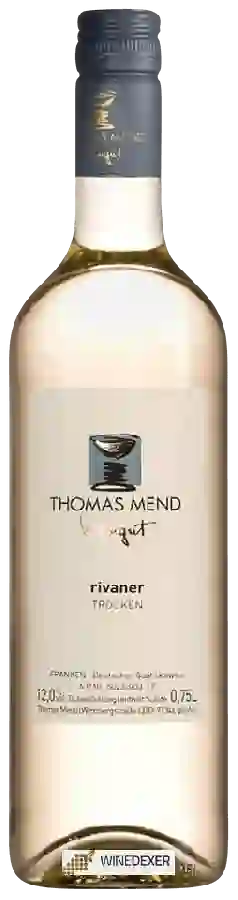
Winery Thomas MendRivaner Trocken
 White wine


In the mouth this white wine is a .
This wine generally goes well with vegetarian, appetizers and snacks or lean fish.

Taste structure of the Rivaner Trocken from the Winery Thomas Mend
Light | Bold | |
Dry | Sweet | |
Soft | Acidic |
In the mouth the Rivaner Trocken of Winery Thomas Mend in the region of Franken is a .
Food and wine pairings with Rivaner Trocken
Pairings that work perfectly with Rivaner Trocken



Original food and wine pairings with Rivaner Trocken


The Rivaner Trocken of Winery Thomas Mend matches generally quite well with dishes of shellfish, spicy food or vegetarian such as recipes of pasta with vongoles (flat clams), rib steak, tomato sauce, peppers. or quiche with bacon and gruyère cheese.
Details and technical informations about Winery Thomas Mend's Rivaner Trocken.
Discover the grape variety: Sauvignonasse
Dry, structured, aromatic whites with a pale golden hue, a broad palate and preserved acidity, featuring fresh almond, pear, apple, citrus, white flowers, cut herbs and mineral notes. Fine ageing potential. Star of Friuli Colli Orientali DOC and Collio DOC as Friulano (emblem of Friuli). Also grown in Chile (Sauvignon Vert) and Slovenia. Native south-west variety, long confused with sauvignon blanc.
Last vintages of this wine
The best vintages of Rivaner Trocken from Winery Thomas Mend are 0
Informations about the Winery Thomas Mend
The Winery Thomas Mend is one of of the world's great estates. It offers 34 wines for sale in the of Franken to come and discover on site or to buy online.

The wine region of Franken
Homeland of German Silvaner: dry, straight, mineral and lively whites with notes of green apple, citrus, fresh herbs and a saline touch, planted here for over 350 years (1,500 ha, a quarter of the vineyard). Also supple, floral Müller-Thurgau, taut Riesling, aromatic Bacchus. Some discreet reds (Spätburgunder). 6,040 ha in Bavaria along the Main around Würzburg, red sandstone and shell-limestone soils.
The word of the wine: Cooperative cellar
A collective production structure to which winegrowers belong in order to pool their grapes, transform them into wine and ensure its marketing.