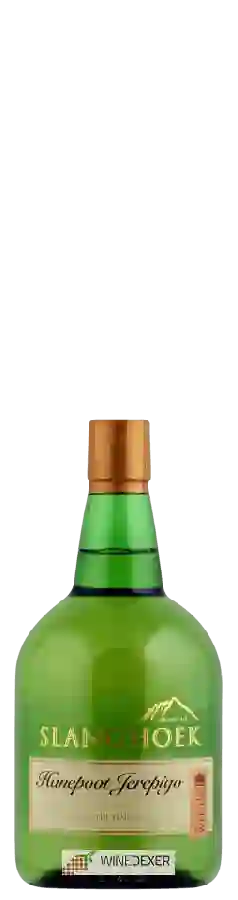
Winery SlanghoekHanepoot Jerepigo
 Sweet wine



This wine generally goes well with
Details and technical informations about Winery Slanghoek's Hanepoot Jerepigo.
Discover the grape variety: Goron de Bovernier
Its origin is most certainly Valdôtaine (Italy), still cultivated in the Entremont Valley in the Swiss Valais and totally unknown in other countries. It is the result of a natural cross between a still unknown or even extinct variety and the Cornalin du Valais or rouge du pays. It is the grandson of the humagne rouge or petit rouge and would also have genetic links with the rèze and the chasselas. The Goron de Bovernier is registered in the Official Catalogue of wine grape varieties list B.
Last vintages of this wine
The best vintages of Hanepoot Jerepigo from Winery Slanghoek are 0, 2016, 2015
Informations about the Winery Slanghoek
The Winery Slanghoek is one of of the world's greatest estates. It offers 28 wines for sale in the of Slanghoek to come and discover on site or to buy online.

The wine region of Slanghoek
The wine region of Slanghoek is located in the region of Breedekloof of Western Cape of South Africa. Wineries and vineyards like the Domaine Opstal or the Domaine Opstal produce mainly wines red, white and sweet. The most planted grape varieties in the region of Slanghoek are Chenin blanc, Cabernet-Sauvignon and Colombard, they are then used in wines in blends or as a single variety. On the nose of Slanghoek often reveals types of flavors of non oak, microbio or oak and sometimes also flavors of tree fruit, spices or citrus fruit.
The wine region of Western Cape
The Western Cape is home to the vast majority of the South African wine industry, and the country's two most famous wine regions, Stellenbosch and Paarl. The city of Cape Town serves as the epicenter of the Cape Winelands, a mountainous, biologically diverse area in the south-western corner of the African continent. A wide variety of wines are produced here. Wines from the Shiraz and Pinotage">Pinotage grape varieties can be fresh and juicy or Full-bodied and gutsy.
The word of the wine: Douçâtre
Soft wine with a dominant sweetness at the expense of freshness.