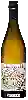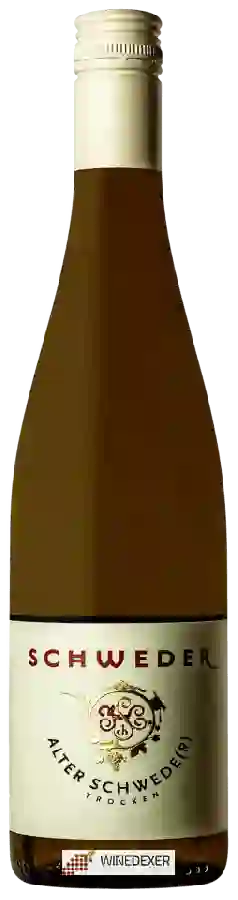
Winery SchwederAlter Schwede Trocken
 White wine


In the mouth this white wine is a with a nice freshness.
This wine generally goes well with rich fish (salmon, tuna etc), shellfish or mild and soft cheese.
Taste structure of the Alter Schwede Trocken from the Winery Schweder
Light | Bold | |
Dry | Sweet | |
Soft | Acidic |
In the mouth the Alter Schwede Trocken of Winery Schweder in the region of Pfalz is a with a nice freshness.
Food and wine pairings with Alter Schwede Trocken
Pairings that work perfectly with Alter Schwede Trocken



Original food and wine pairings with Alter Schwede Trocken

The Alter Schwede Trocken of Winery Schweder matches generally quite well with dishes of rich fish (salmon, tuna etc), shellfish or mild and soft cheese such as recipes of chinchards with white wine and grapes, zarzuela mayonapo or indian pizza.
Details and technical informations about Winery Schweder's Alter Schwede Trocken.
Discover the grape variety: Rougeon
Interspecific crossing obtained by Albert Seibel between 70 Jaeger and 3015 Seibel. It can still be found in the eastern part of the United States, ... practically unknown in France.
Last vintages of this wine
The best vintages of Alter Schwede Trocken from Winery Schweder are 2019, 0, 2017
Informations about the Winery Schweder
The Winery Schweder is one of of the world's greatest estates. It offers 21 wines for sale in the of Pfalz to come and discover on site or to buy online.

The wine region of Pfalz
Pfalz is a key wine producing region in western Germany, located between the Rhein/Rhine river and the low-lying Haardt mountain range (a natural continuation of the Alsatian Vosges). It covers a rectangle of land 45 miles (75km) Long and 15 miles (25km) wide. To the NorthLiesRheinhessen; to the South, the French border and Alsace. In terms of both quality and quantity, Pfalz is one of Germany's most important regions, and one which shows great promise for the future.
The word of the wine: Cep
Grapevine.