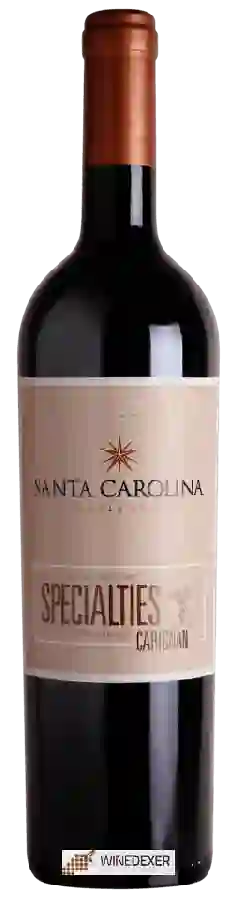
Winery Santa CarolinaDry Farming Carignan
 Red wine



This wine generally goes well with beef and spicy food.

Wine flavors and olphactive analysis



On the nose the Dry Farming Carignan of Winery Santa Carolina in the region of Central Valley often reveals types of flavors of earth, oak or black fruit.
Food and wine pairings with Dry Farming Carignan
Pairings that work perfectly with Dry Farming Carignan


Original food and wine pairings with Dry Farming Carignan
The Dry Farming Carignan of Winery Santa Carolina matches generally quite well with dishes of beef or spicy food such as recipes of hungarian goulash or fideuà (spain).
Details and technical informations about Winery Santa Carolina's Dry Farming Carignan.
Discover the grape variety: Bertille Seyve 450
Simple, fresh dry whites with a pale golden colour, a supple palate with moderate acidity and understated aromas of citrus and white flowers. Productive rustic profile. Now marginal, it survives in a few heritage plots and is one of the old French hybrids preserved in varietal collections. French white hybrid variety obtained in the early 20th century by Bertille Seyve, in the lineage of phylloxera-resistant crossings.
Last vintages of this wine
The best vintages of Dry Farming Carignan from Winery Santa Carolina are 2011, 2010, 2008, 0 and 2009.
Informations about the Winery Santa Carolina
The Winery Santa Carolina is one of of the world's great estates. It offers 204 wines for sale in the of Central Valley to come and discover on site or to buy online.

The wine region of Central Valley
Heart of modern Chilean wine: structured, sunny reds, dense, blackcurranty Cabernet Sauvignon from Maipo (Chilean cradle of the grape), signature Carménère with notes of ripe pepper, black fruit and sweet spices from Colchagua, supple Merlot and deep Syrah. Round Chardonnay whites and lively, sharp Sauvignon. Mediterranean climate, 400 km between Andes and Pacific. Star sub-regions: Maipo, Cachapoal, Colchagua, Curicó, Maule.
The word of the wine: Vintage scale
Complex system of classification of the communes of Champagne according to the value of the grapes which are produced there. In other regions, hierarchical situation of the productions classified by various authorities.