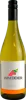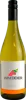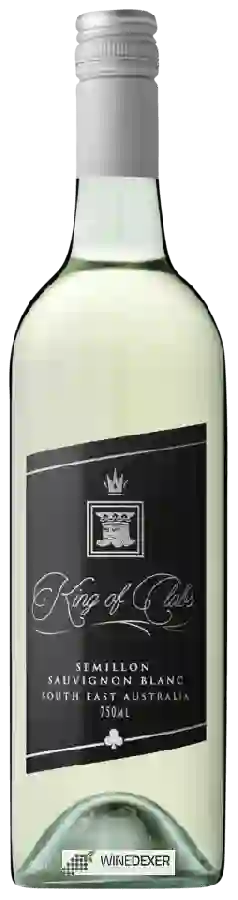
Winery Sans+PareilKing of Clubs Sémillon - Sauvignon Blanc
 White wine
This wine generally goes well with vegetarian, poultry or rich fish (salmon, tuna etc).
Food and wine pairings with King of Clubs Sémillon - Sauvignon Blanc
Pairings that work perfectly with King of Clubs Sémillon - Sauvignon Blanc



Original food and wine pairings with King of Clubs Sémillon - Sauvignon Blanc


The King of Clubs Sémillon - Sauvignon Blanc of Winery Sans+Pareil matches generally quite well with dishes of rich fish (salmon, tuna etc), shellfish or sweet desserts such as recipes of cucumber pie, spaghetti with shrimp and cream or express cherry clafoutis.
Details and technical informations about Winery Sans+Pareil's King of Clubs Sémillon - Sauvignon Blanc.
Discover the grape variety: Putzcheere
It is believed to have originated in Hungary, in the region bordering Romania, from where it spread to Germany, Alsace and the southwest of France, particularly in the Gers and high Pyrenees departments. It is also found in the United States (California). Today, it is almost absent from French vineyards. - Synonyms: putchir, putscher, butschera (for all the synonyms of the grape varieties, click here!)
Informations about the Winery Sans+Pareil
The Winery Sans+Pareil is one of of the world's great estates. It offers 13 wines for sale in the of Australie du Sud-Est to come and discover on site or to buy online.

The wine region of Australie du Sud-Est
South East Australia is a geographical indication (GI) covering the entire south-eastern third of Australia. The western boundary of this area extends 2,000 kilometres (1,250 miles) across the Australian continent from the Pacific coast of Queensland to the Southern Ocean coast of South Australia. This vast wine 'super zone' effectively encompasses all the major Australian wine regions outside Western Australia. Rainforest, mountain ranges, scrubland, desert and Dry riverbeds occupy the majority of the land in the South East Australian area.
The word of the wine: Presses
The juice that results from pressing the grapes after fermentation. At the end of the maceration, the vats are emptied, the first juice obtained is called the free-run wine and the marc remaining at the bottom of the vat is then pressed to give the press wine. We say more quickly "the presses". Their quality varies according to the vintage and the maceration. A too vigorous extraction releases the tannins of pips and the wine of press can then prove to be very astringent. Often the winemaker raises it separately, deciding later whether or not to incorporate it totally or partially into the grand vin.