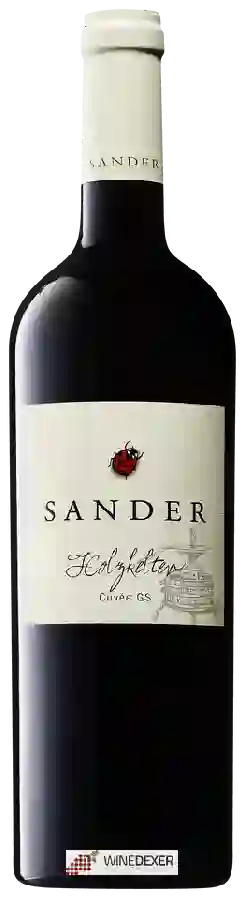
Winery SanderHolzkelter Cuvée GS
 Red wine



This wine generally goes well with
Details and technical informations about Winery Sander's Holzkelter Cuvée GS.
Discover the grape variety: Red Globe
Obtained in the United States (California) in 1957 by Harold P. Olmo and Albert T. Koyama by crossing (hunisa x emperor) with (hunisa x emperor x nocera). It is found in the United States (California, ...), Spain, Portugal, Italy (Sicily, ...), Turkey, Chile, Argentina, South Africa, ... in France, it is not known, registered since the 03.05.2010 in the official catalogue list A2.
Last vintages of this wine
The best vintages of Holzkelter Cuvée GS from Winery Sander are 2017, 0
Informations about the Winery Sander
The Winery Sander is one of of the world's great estates. It offers 57 wines for sale in the of Rheinhessen to come and discover on site or to buy online.

The wine region of Rheinhessen
Rheinhessen is Germany's largest region for producing the quality wines of the Qualitätswein bestimmter Anbaugebiete (QbA) and Prädikatswein designations, with roughly 26,500 hectares (65,000 acres) of Vineyard">Vineyards as of 2014. Many of its most significant viticultural areas are favorably influenced by the Rhine river, which runs aLong its North and eastern borders. The Rhine, along with the Nahe river to the west and the Haardt mountains to its South, form a natural border. Rheinhessen covers an area south of Rheingau, north of Pfalz and east of Nahe, and is located within the Rhineland-Palatinate federal state.
The word of the wine: Animal
Generic smell of aromatic families reminiscent of fur, game, musk, civet, amber and sometimes unpleasant smells of wet hair. The old books on tasting give as an example of animal aroma the belly of hare.