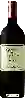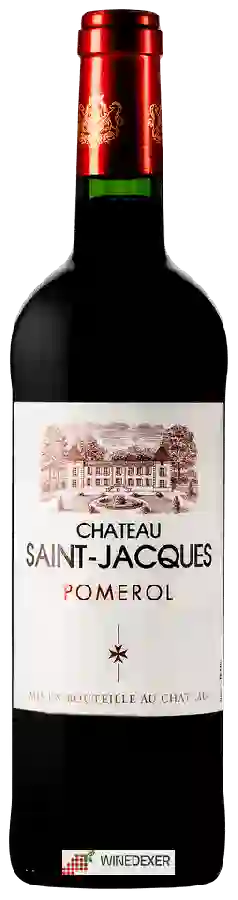
Château Saint-JacquesPomerol
 Red wine


In the mouth this red wine is a powerful with a nice balance between acidity and tannins.
This wine generally goes well with poultry, beef or game (deer, venison).

Taste structure of the Pomerol from the Château Saint-Jacques
Light | Bold | |
Smooth | Tannic | |
Dry | Sweet | |
Soft | Acidic |
In the mouth the Pomerol of Château Saint-Jacques in the region of Bordeaux is a powerful with a nice balance between acidity and tannins.
Wine flavors and olphactive analysis


On the nose the Pomerol of Château Saint-Jacques in the region of Bordeaux often reveals types of flavors of strawberries, cassis or earth and sometimes also flavors of red fruit, black fruit.
Food and wine pairings with Pomerol
Pairings that work perfectly with Pomerol



Original food and wine pairings with Pomerol

The Pomerol of Château Saint-Jacques matches generally quite well with dishes of beef, lamb or game (deer, venison) such as recipes of spaghetti bolognese, lamb tagine with quince or rabbit with kriek and cherries.
Details and technical informations about Château Saint-Jacques's Pomerol.
Discover the grape variety: Durif
Powerful, deeply coloured reds with an inky, near-black robe, firm tannins and dense palate. Intense aromas of blackberry, plum, blackcurrant, black pepper, chocolate, spices and balsamic notes. Fine ageing potential. Near-extinct in France, it became a star as Petite Sirah in California (Napa, Lodi, Paso Robles) and is emblematic of Rutherglen, Australia. French variety created in 1880 by François Durif in the Isère (spontaneous cross of Syrah × Peloursin).
Last vintages of this wine

The best vintages of Pomerol from Château Saint-Jacques are 2016, 2015, 2014, 2013 and 2012.
Informations about the Château Saint-Jacques
The Château Saint-Jacques is one of of the world's greatest estates. It offers 2 wines for sale in the of Pomerol to come and discover on site or to buy online.

The wine region of Pomerol
Absolute myth of the Bordeaux right bank (Libournais): signature Merlot as king red (~80%) — deep robe and opulent profile with black truffle, candied cherry, plum, chocolate, violet, leather and a mineral touch, signature creamy velvety texture and an endless finish. Fragrant Cabernet Franc as backup. Cradle of Pétrus and Le Pin. AOC (1936), ~800 ha without classification, blue clay and ferruginous crasse de fer plateau, ageing 10-50 years.
The wine region of Bordeaux
World-renowned age-worthy reds, led by round Merlot (plum, black fruit) or firm Cabernet Sauvignon (blackcurrant, cedar, graphite), blended with Cabernet Franc and Petit Verdot for tannic structure. Structured Médoc and Graves, velvety Saint-Émilion and Pomerol. Also crisp dry whites (Sauvignon/Sémillon) and opulent sweet Sauternes with honey and candied fruit. A 110,000 ha Gironde vineyard, 65 appellations, cradle of the 1855 classified growths.
The word of the wine: Malolactic fermentation
Called second fermentation or malo for short. It is the degradation (under the effect of bacteria) of the malic acid naturally present in the wine into milder, less aggressive lactic acid. Some producers or wineries refuse this operation by "blocking the malo" (by cold and adding SO2) to keep a maximum of acidity which carries the aromas and accentuates the sensation of freshness.