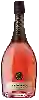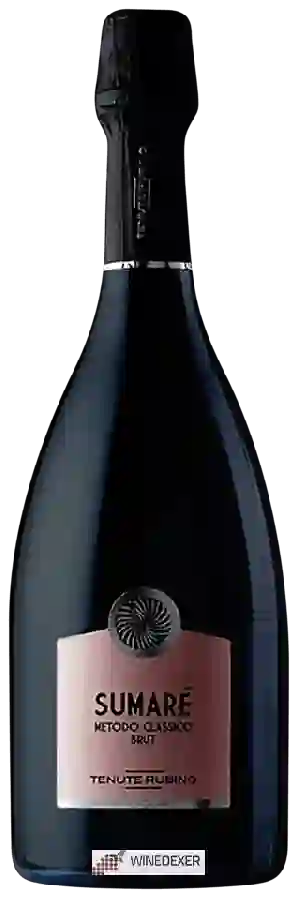
Winery Tenute RubinoSumaré Metodo Classico Brut
 Sparkling wine



This wine generally goes well with
Wine flavors and olphactive analysis


On the nose the Sumaré Metodo Classico Brut of Winery Tenute Rubino in the region of Puglia often reveals types of flavors of non oak, microbio or spices and sometimes also flavors of red fruit.
Details and technical informations about Winery Tenute Rubino's Sumaré Metodo Classico Brut.
Discover the grape variety: Assyrtiko
This is a very old grape variety grown in Greece, particularly in the southern Cyclades Islands in the Aegean Sea, and more specifically in the Santorini archipelago. It is related to gaidouria and platani. In this country, it is quite often "associated" with other grape varieties such as aïdani, athiri, malagousia, ... . Assyrtiko can be found in Germany, Spain, Italy, Greece, Cyprus, Bulgaria, Romania, the United States, Mexico, South Africa, etc. Little known in France, it is nevertheless registered in the Official Catalogue of wine grape varieties, list A.
Last vintages of this wine
The best vintages of Sumaré Metodo Classico Brut from Winery Tenute Rubino are 2013, 2015, 2012, 0 and 2014.
Informations about the Winery Tenute Rubino
The Winery Tenute Rubino is one of of the world's great estates. It offers 32 wines for sale in the of Salento to come and discover on site or to buy online.

The wine region of Salento
The wine region of Salento is located in the region of Pouilles of Italy. We currently count 851 estates and châteaux in the of Salento, producing 2704 different wines in conventional, organic and biodynamic agriculture. The wines of Salento go well with generally quite well with dishes .
The wine region of Puglia
Puglia (Apulia to many English speakers) is a Long, slender wine region in the extreme Southeast corner of Italy's "boot". To use the shoe analogy often used to illustrate the shape of Italy, Apulia extends from the tip of the heel to the mid-calf, where the spur of the Gargano Peninsula juts out into the Adriatic Sea. The heel (the Salento peninsula) occupies the southern half of the region and is of great importance for the identity of Puglia. Not only are there cultural and geographical differences from Northern Puglia, but the wines are also different.
The word of the wine: Tertiary aromas
Aromas resulting from the aging of the wine in the bottle. The aromas evolve with time, from fresh fruitiness to notes of stewed, candied or dried fruit, to aromas of venison or undergrowth.